Your team already calls customers from their mobile phones. The problem isn't the calling. It's everything around it: which lead goes to whom, what happened on the call, and who forgot the callback.
A call tracking app shows you the calls. A SIM based call management system runs the whole telecalling process on your team's own SIM cards.
This guide shows how the system works, the 5-Stage Call Loop we recommend, 12 ready call outcome codes, the 6 numbers a manager should check every day, a 30-day rollout plan, and the SIM and TRAI rules that changed in 2023 and 2025.
A SIM based call management system is software that runs a sales team's calling process on ordinary mobile SIM cards: it assigns leads, lets staff call from their Android phone, logs each call and its outcome automatically, schedules follow-ups, and gives managers reports, without VoIP lines, desk phones or a call centre setup.
Quick answer
- A SIM based call management system covers five stages: capture leads, assign them, call on the phone's SIM, log the call outcome, and follow up and review.
- Calls run on the employee's normal mobile network and plan, while the app syncs call logs, durations and recordings (where the phone saves them) to a CRM.
- Firms that contacted online leads within an hour were nearly 7 times as likely to qualify them as firms that waited longer (Harvard Business Review, 2011).
- Since August 2023, the Department of Telecommunications has required KYC of every end user on business SIM connections.
- TRAI's February 2025 rules restrict ordinary 10-digit numbers for telemarketing; repeat violators face one-year disconnection of all telecom resources.
Contents
- How a SIM based call management system works
- Call management vs call tracking vs cloud telephony
- The 5-Stage Call Loop
- 12 call outcome codes to use
- 6 KPIs to check every day
- SIM and TRAI rules in 2026
- 30-day rollout plan
- FAQ
Disclosure: Mera Udyog is our own product. This guide explains the method; for a side-by-side tool comparison, see our SIM based call tracking software guide.
How a SIM Based Call Management System Works
A SIM based call management system works by putting a CRM app on each salesperson's Android phone: leads arrive in the app, the salesperson taps to call through the phone's normal dialer and SIM, and the app reads the call log after the call and saves it against the lead with an outcome and a next follow-up date.
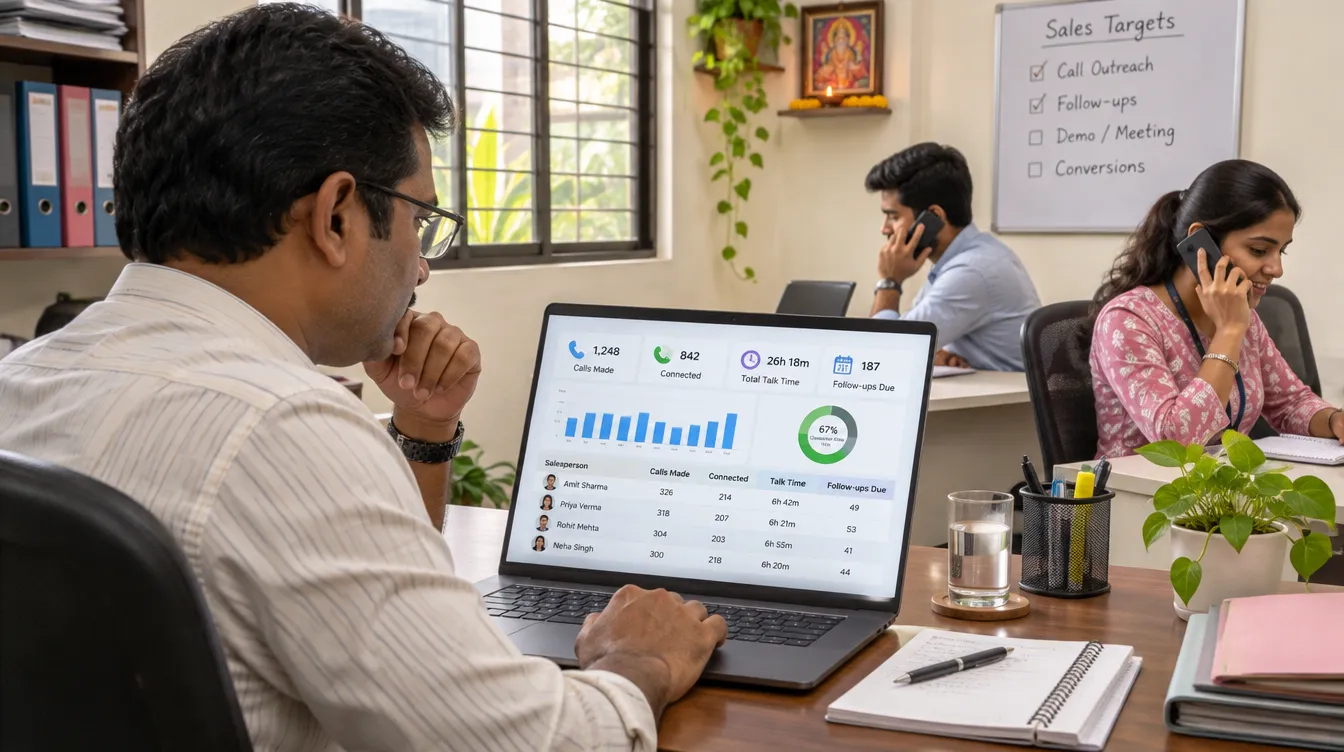
Four parts make it work:
| Part | What it does | Where it runs |
|---|---|---|
| Lead inbox | Collects enquiries from IndiaMART, website forms, Facebook lead ads, walk-ins and imports | CRM (web and app) |
| Assignment rules | Gives each lead an owner by round robin, territory, product or language | CRM |
| Phone app | Shows the day's call list, dials through the SIM, reads the call log, uploads recordings | Android phone |
| Manager dashboard | Calls, connect rate, talk time, overdue follow-ups, untouched leads | CRM (web) |
Two technical limits are worth knowing before you buy. Call recording depends on the phone's own dialer, so it works on some phone brands and not others.
And iPhones don't let third-party apps read SIM call logs, so automatic logging works fully only on Android. Our call tracking guide has the phone-by-phone table.
Call Management System vs Call Tracking vs Cloud Telephony
A call tracking app only records which calls happened, a call management system also decides who calls whom and what happens next, and cloud telephony moves the calls themselves onto virtual numbers and servers. Most Indian SME sales teams need the middle option.
| Call tracking app | SIM based call management system | Cloud telephony / VoIP | |
|---|---|---|---|
| Logs calls from the SIM | Yes | Yes | No (calls run on virtual numbers) |
| Assigns leads to callers | No | Yes | Sometimes (via queues) |
| Call outcome and follow-up date | No | Yes | Via CRM integration |
| Number the customer sees | Salesperson's mobile | Salesperson's or company SIM | Virtual or landline number |
| IVR, call queues, inbound routing | No | Limited | Yes |
| Call cost | Existing SIM plan | Existing SIM plan | Per minute or per channel |
| Best for | Owners who just want visibility | Field sales, dealer networks, telecalling teams up to a few dozen people | Inbound helplines and large call floors |
Runo, for example, sells itself as a SIM-based call management CRM for outbound sales and telecalling (Runo), while TeleCRM lists auto-assignment by location, product or team and duplicate detection as core features (TeleCRM). Those assignment and follow-up features are what separate management from tracking.
The 5-Stage Call Loop for SIM Based Call Management
The 5-Stage Call Loop is our name for the telecalling process that SIM based call management should enforce: Capture, Assign, Call, Log and Follow up, with a time limit at every stage so no lead waits and no callback is forgotten.
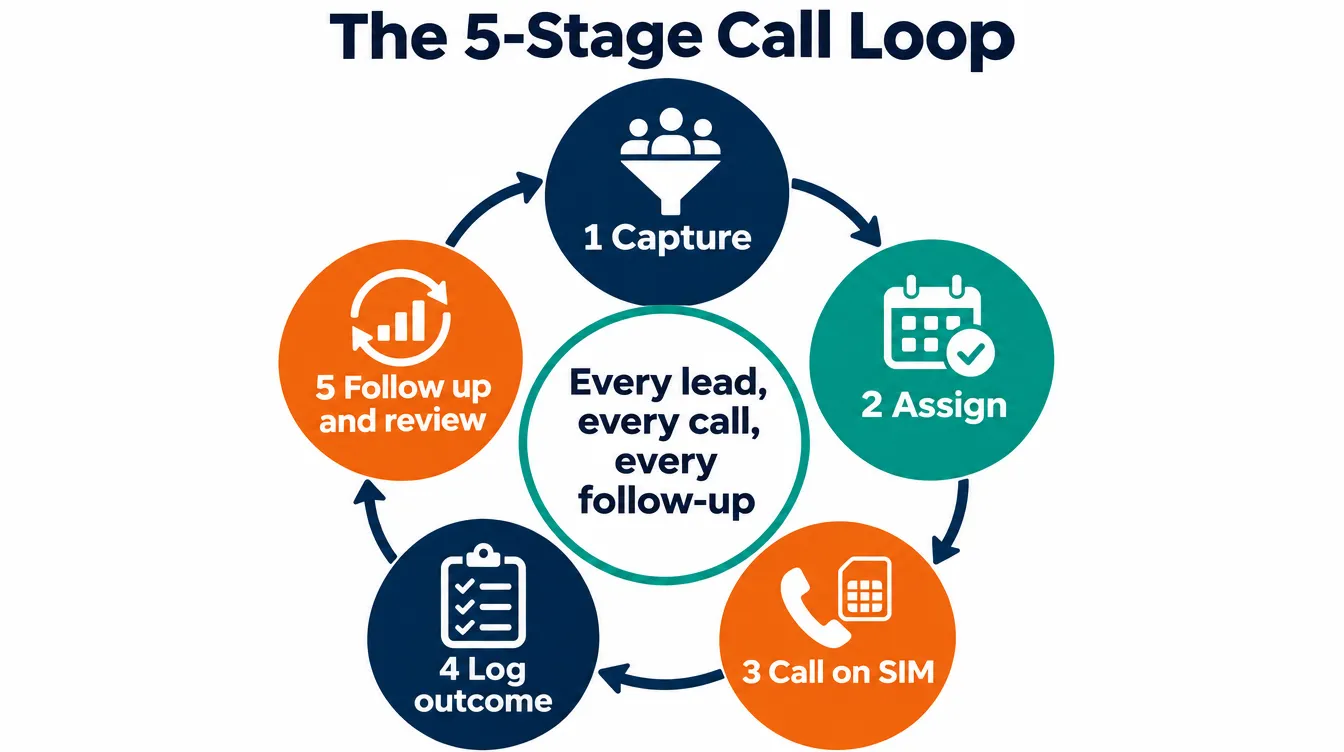
| Stage | What happens | Time limit we suggest | What the system should do |
|---|---|---|---|
| 1. Capture | Every enquiry lands in one inbox | Instant | Pull leads from IndiaMART, website, Facebook and WhatsApp; block duplicates |
| 2. Assign | Lead gets one owner | Within 5 minutes | Round robin or rule-based assignment, with a notification on the phone |
| 3. Call | Telecaller makes the first call on the SIM card | Within 1 hour of the enquiry | One-tap dial from the lead; call logged automatically |
| 4. Log | Outcome code and note saved | Before the next call | Force an outcome code when the call ends |
| 5. Follow up and review | Next call date set; manager reviews gaps | Same day for hot leads | Reminders, overdue list, daily report |
Why one hour for the first call? In a Harvard Business Review audit of 2,241 US companies, firms that tried to contact a lead within an hour were nearly 7 times as likely to qualify it as those that waited even an hour longer, and more than 60 times as likely as those that waited 24 hours or more (Fronetics summary of HBR, 2011). The same audit found only 37% of companies responded within an hour.
The data is from US firms in 2011, but the logic holds for any enquiry from IndiaMART or a Facebook form: buyers often send the same enquiry to several suppliers, and the first useful call gets their attention.
12 Call Outcome Codes for a SIM Based Telecalling Team
A call outcome code (also called a call disposition) is the label a caller picks after every call, such as "Interested" or "Call back later", and each code should trigger a fixed next action and follow-up date. Without fixed codes, notes become "spoke, will see" and reports become useless.
Use these 12 codes as a starting list. Keep the total under 15, or callers start picking the first one in the list.
| # | Outcome code | Meaning | Next action | Follow-up |
|---|---|---|---|---|
| 1 | Not picked | Rang, no answer | Retry at a different time of day | Same day, +3 hours |
| 2 | Busy / cut | Customer rejected or line busy | Retry later | Same day, +2 hours |
| 3 | Switched off / not reachable | Phone off or out of network | Send WhatsApp message, retry | Next day |
| 4 | Wrong number | Not the person who enquired | Mark invalid; check the source | Close |
| 5 | Call back later | Asked for a specific time | Set reminder at that time | As requested |
| 6 | Interested: send details | Wants catalogue, price list or photos | Send on WhatsApp or email within 15 minutes | Next day |
| 7 | Quotation requested | Ready for a price | Send quotation | 2 days after quote |
| 8 | Visit or demo booked | Meeting fixed | Confirm a day before | On visit date |
| 9 | Negotiation | Discussing price or terms | Manager review | 2 to 3 days |
| 10 | Not interested: price | Lost on price | Note competitor price | Re-contact in 90 days |
| 11 | Not interested: other | No need, bought elsewhere | Capture reason | Close or 180 days |
| 12 | Converted | Order or booking confirmed | Hand over to order team | Close |
Two rules make the codes work:
- Every open code must carry a follow-up date. A lead with code 5, 6, 7, 8 or 9 and no date is a lead you will lose.
- Cap retries on no-answer codes. Decide a number, for example 4 attempts over 3 days at different times, then move the lead to a WhatsApp nurture list instead of calling forever.
If you quote often, our quotation format in Excel includes a Quote Tracker that works the same way for code 7.
6 Call KPIs Every Manager Should Check Daily
Six numbers tell a manager whether a SIM based calling team is working: connect rate, first-call time, talk time per connected call, follow-up compliance, untouched leads and missed-call return rate. Total calls dialled, the number most owners look at, is the least useful on its own.
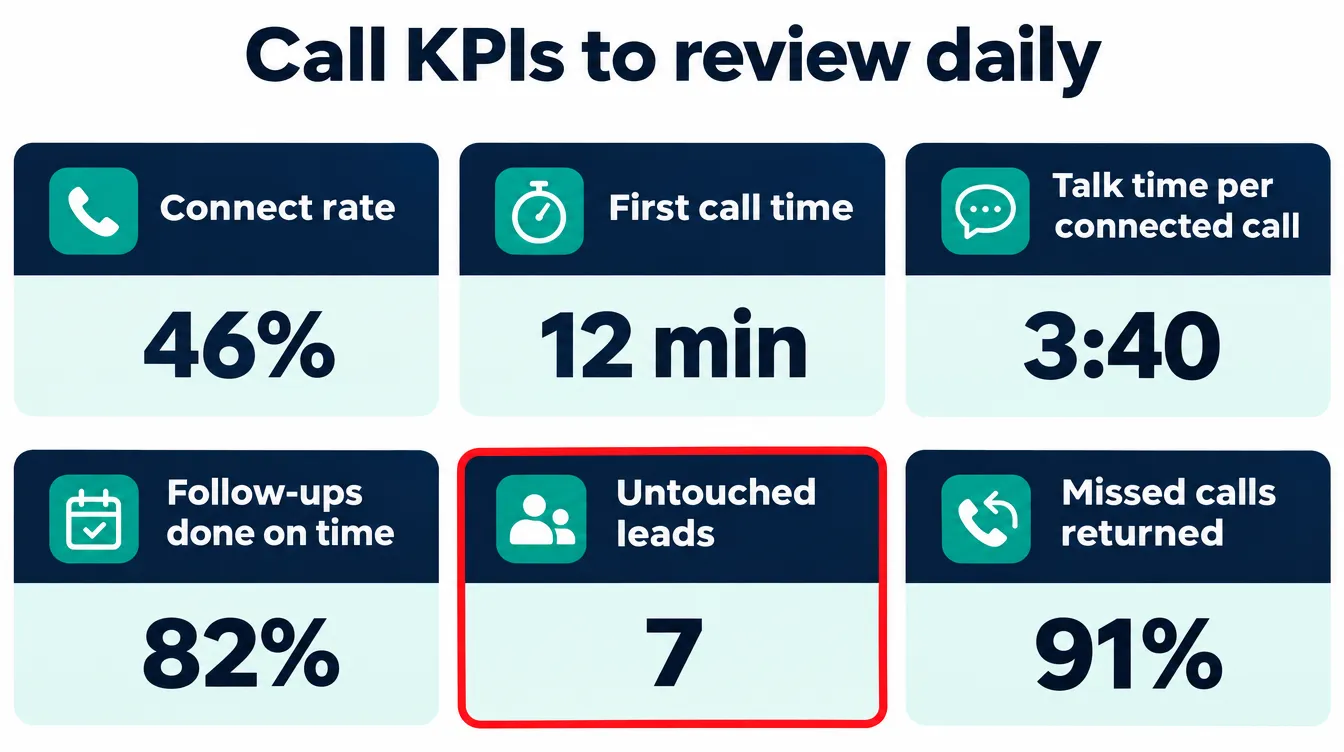
| KPI | Formula | What it tells you |
|---|---|---|
| Connect rate | Connected calls ÷ calls dialled | Data quality and calling times |
| First-call time | Time from lead arrival to first call | Speed to lead (target: under 1 hour) |
| Talk time per connected call | Total talk time ÷ connected calls | Whether conversations are real or 10-second hang-ups |
| Follow-up compliance | Follow-ups done on the due date ÷ follow-ups due | Discipline; the most common leak |
| Untouched leads | Leads assigned but never called | Leads paid for and wasted |
| Missed-call return rate | Missed customer calls returned within 2 hours ÷ missed customer calls | Inbound enquiries you are ignoring |
What's a normal connect rate? Callyzer reports a 46 to 48% connect rate across more than 5 crore calls on its platform (Callyzer, October 2026). That is vendor data, so use it as a rough reference and set your own baseline in the first two weeks.
The daily 10-minute review: at 6 pm, sort callers by untouched leads, then by overdue follow-ups. Fix those two lists before looking at anything else.
SIM and TRAI Rules for SIM Based Calling in 2026
Three sets of rules apply to SIM based calling teams in India: DoT's KYC rules for business SIM connections, TRAI's 2025 rules on commercial calls from 10-digit numbers, and data protection rules for call logs and recordings. This is general information, not legal advice.
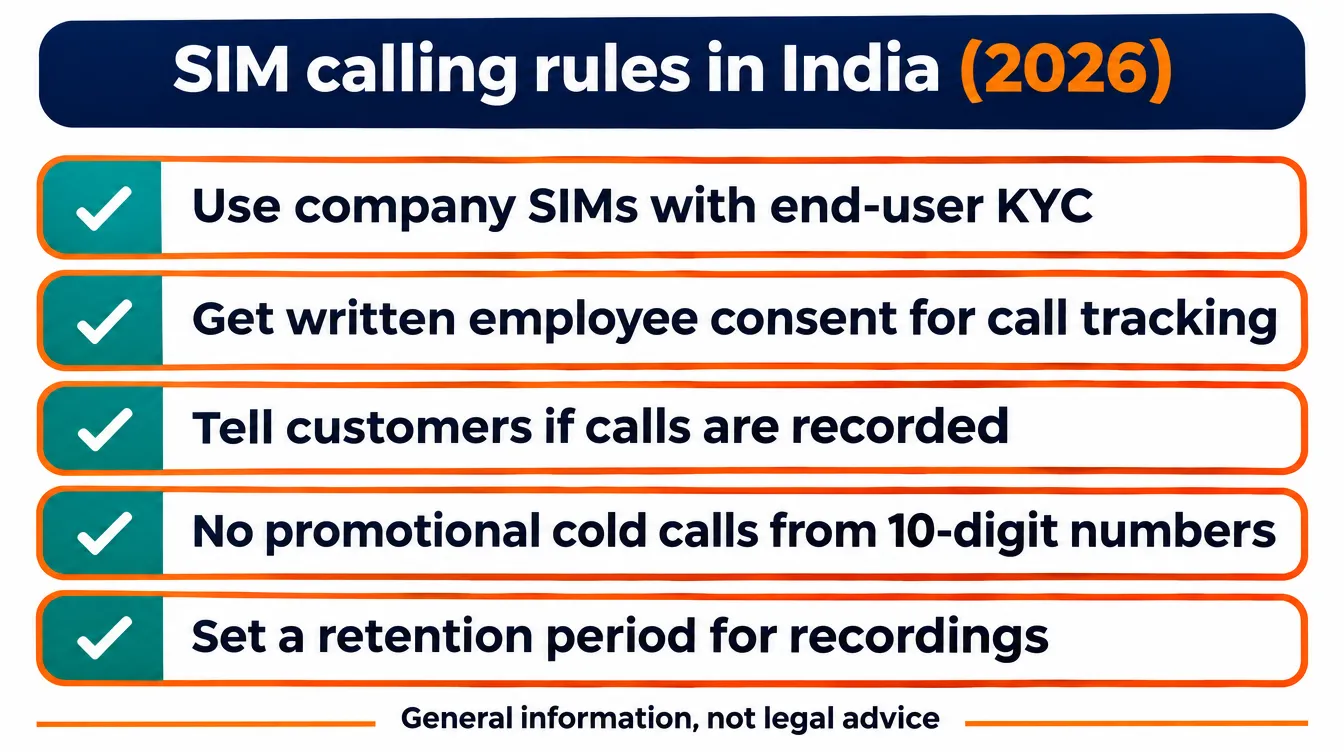
Company SIMs: KYC for every end user
In August 2023 the Department of Telecommunications discontinued "bulk connections" and created a "business connections" category, with KYC verification of end users (Trilegal). Businesses can take any number of connections, but every end user must complete KYC before the SIM is activated (Swarajya).
In June 2025 DoT also removed KYC flexibility for mobile numbers used in bulk business calling (BizzBuzz).
What this means in practice: when a salesperson leaves, the company SIM stays with you, but the operator needs KYC of the new user. One KYC guide says businesses must inform the operator and complete the new user's KYC within 7 days (HyperVerge); confirm the timeline with your operator.
Why company SIMs are worth it: when a salesperson leaves with a personal number, your customers keep calling them. A company SIM keeps the number, the call history and the customer relationship with the business.
TRAI 2025: no telemarketing from ordinary 10-digit numbers
TRAI's amendments to the Telecom Commercial Communications Customer Preference Regulations (TCCCPR), announced on 12 February 2025, restrict senders from using normal 10-digit numbers for telemarketing; promotional calls must use the 140 series and transactional and service calls the 1600 series (TRAI press release).
The penalties fall on the sender's numbers, not just on the caller:
| Rule | Detail |
|---|---|
| Action trigger | 5 complaints in the last 10 days (earlier 10 in 7 days) |
| Customer complaint window | 7 days from the call (earlier 3) |
| First violation | Outgoing services on all the sender's telecom resources barred for 15 days |
| Repeat violation | All telecom resources disconnected for one year across operators, and the sender blacklisted |
| Consent | Consent for an ongoing transaction is valid for 7 days; after an opt-out, consent cannot be sought again for 90 days |
Source: TRAI Press Release No. 11/2025.
What this means for a SIM based team: calling people who enquired about your product, existing customers, and follow-ups on a live deal is the normal use. Cold-calling bought lists from salespeople's 10-digit SIMs is the risky use. Five complaints of unsolicited commercial communication (UCC) can take every company SIM offline, and customers registered on DND are the most likely to complain.
B2B calls are being contested.
IndiaMART has challenged Regulation 25 of the amended TCCCPR in the Delhi High Court as far as it applies to business-to-business communication (Bar & Bench), and the court issued notice to TRAI and DoT in December 2025 (Informist).
Until the court decides, treat B2B cold calling with the same caution. Check the case's latest status before you rely on this.
Call logs and recordings: tell people
Call logs and recordings are personal data. Put a written call monitoring policy in place, get each employee's acknowledgement, tell customers when calls are recorded, and set a retention period. Our call tracking guide covers the DPDP Act timelines.
How to Set Up a SIM Based Call Management System in 30 Days
You can roll out SIM based call management in about 30 days in four weekly steps: set up the process, pilot with a few callers, roll out to the team, then review and tighten. Most failures come from skipping the pilot.
| Week | What to do | Done when |
|---|---|---|
| 1. Set up | Connect lead sources, import open leads, set assignment rules, load the 12 outcome codes, write the call monitoring policy | Every new enquiry lands in one inbox with an owner |
| 2. Pilot | 3 to 5 callers on their real phones; check logs, recordings and battery settings on each phone model | All pilot calls sync within 15 minutes, with outcomes |
| 3. Roll out | Whole team, 30-minute training, daily 6 pm review starts | No untouched leads older than a day |
| 4. Review | Compare KPIs with week 2; fix codes nobody uses; set retry caps | Baseline connect rate and first-call time recorded |
Pro tip: before day one, turn off battery optimisation for the calling app on every phone. When the phone kills the app in the background, calls stop syncing and the manager blames the salesperson.
When a SIM Based System Is Not Enough
Move to cloud telephony when you need inbound call queues and IVR, server-side recording of every call regardless of phone brand, or more than a few dozen seats working one number. A helpline that must route 200 inbound calls an hour across agents has outgrown SIM based calling.
Many teams run both: cloud telephony for the inbound helpline, and SIM based calling for field sales and follow-ups where customers recognise the salesperson's mobile number.
Run Calls and the Rest of Sales in One App
Mera Udyog's sales CRM includes SIM based call tracking, so calls land on the lead record next to quotations, orders and invoices, and the same employee record covers attendance and payroll. It is built for manufacturing units and multi-outlet retail chains.
See the Mera Udyog sales CRM and our attendance and payroll software.
Start With the Loop, Then the Software
A SIM based call management system is only as good as the process it enforces. Write down your 5-Stage Call Loop with time limits, load the 12 outcome codes, check the 6 KPIs every evening, and use company SIMs with a clear policy.
Then pick the software that enforces it on your team's real phones. Shortlist tools in our SIM based call tracking software comparison, or try Mera Udyog free for 7 days.
Start 7-Day Free Trial · Book a Free Demo · See pricing
FAQ: SIM Based Call Management System
What is a SIM based call management system?
A SIM based call management system is software that runs a sales team's calling on ordinary mobile SIMs. It assigns leads, lets staff call from their Android phone, logs each call and its outcome, schedules follow-ups and reports to managers, without VoIP or desk phones.
How is call management different from call tracking?
Call tracking records which calls happened: number, time and duration. Call management also assigns leads, captures the outcome of each call, sets the next follow-up and shows managers overdue and untouched leads.
Does SIM based call management work on iPhone?
Only partly. iPhones don't let third-party apps read SIM call logs or record SIM calls, so automatic logging and recording work fully only on Android phones.
Can I use 10-digit mobile numbers for telemarketing in India?
TRAI's February 2025 amendments restrict senders from using normal 10-digit numbers for telemarketing; promotional calls must come from the 140 series. Repeat violations can lead to one-year disconnection of all the sender's telecom resources.
Do company SIMs need KYC of each employee?
Yes. Since August 2023, DoT's business connection rules require KYC of every end user before a SIM is activated, and the operator needs the new user's KYC when a SIM changes hands.
What call outcome codes should a telecalling team use?
Use 10 to 15 fixed codes, such as Not picked, Busy, Call back later, Interested: send details, Quotation requested, Visit booked, Negotiation, Not interested and Converted, and attach a follow-up date to every open code.
How fast should a salesperson call a new lead?
Within an hour, and sooner where possible. A Harvard Business Review audit found firms that contacted leads within an hour were nearly 7 times as likely to qualify them as firms that waited longer.
About the Author
By Mera Udyog Team. Questions about setting up a SIM based call management system? Write to hello@meraudyog.com.
Sources
- TRAI strengthens consumer protection with amendments to TCCCPR, 2018 (Press Release No. 11/2025), TRAI, February 2025
- Telecommunication law updates: business connections, Trilegal
- Govt steps in to curb cyber fraud: bulk sales of SIM cards banned, Swarajya, August 2023
- Government tightens KYC rules for bulk business mobile numbers, BizzBuzz, June 2025
- KYC in telecom: business connections, HyperVerge
- Delhi High Court seeks Centre's response to IndiaMART's plea, Bar & Bench
- HC notice to TRAI on IndiaMART plea over curbs on B2B calls, Informist, December 2025
- 50% of sales go to the vendor that responds first (HBR 2011 summary), Fronetics
- Why a SIM-based telecalling CRM works better than VoIP dialers in India, Callyzer, October 2026
- SIM-based call management CRM, Runo
- Sales platform features, TeleCRM