A supplier sends the wrong grade of steel. You check your WhatsApp message and realise you never wrote the grade, the delivery date or the rate in one place.
That is the job a purchase order does. It puts what you ordered, at what price and on what terms in writing, before the goods leave the supplier’s gate.
This page gives you a free purchase order format with 8 GST-ready templates for Word and Excel, an Excel sheet that picks CGST plus SGST or IGST on its own, and the 2026 rules most PO templates miss: the MSME 45-day limit, TDS on purchases and the 180-day GST credit rule. Marathi and Hindi versions are included.
Quick answer
A purchase order format is a standard layout for the document a buyer sends a supplier to order goods or services. It shows the buyer’s and supplier’s details and GSTIN, a unique PO number and date, an item table with HSN or SAC codes, quantity, rate and GST, the total, delivery and payment terms, and an authorised signature.
- A GST purchase order should show both GSTINs, a unique PO number, the supplier’s quotation reference, HSN or SAC codes, the CGST plus SGST or IGST split, delivery terms, payment terms and an authorised signature.
- A purchase order is not a GST document; the supplier’s tax invoice is, and your input tax credit depends on it.
- Payment terms to a Udyam-registered micro or small supplier cannot exceed 45 days from acceptance (Section 15, MSMED Act, 2006), or 15 days if nothing is agreed in writing.
- Since 1 April 2026, TDS of 0.1% on purchases above ₹50 lakh from one seller falls under Section 393 of the Income-tax Act, 2025 (earlier Section 194Q).
- You must pay the supplier within 180 days of the invoice date, or reverse the GST input tax credit with interest (Section 16(2), CGST Act).
Free purchase order format: download
Download the Excel template below. It calculates line amounts, GST and totals automatically. Add your letterhead, pick the layout that matches what you buy, and save the PO as a PDF before you send it.
Download purchase-order-format.xlsx
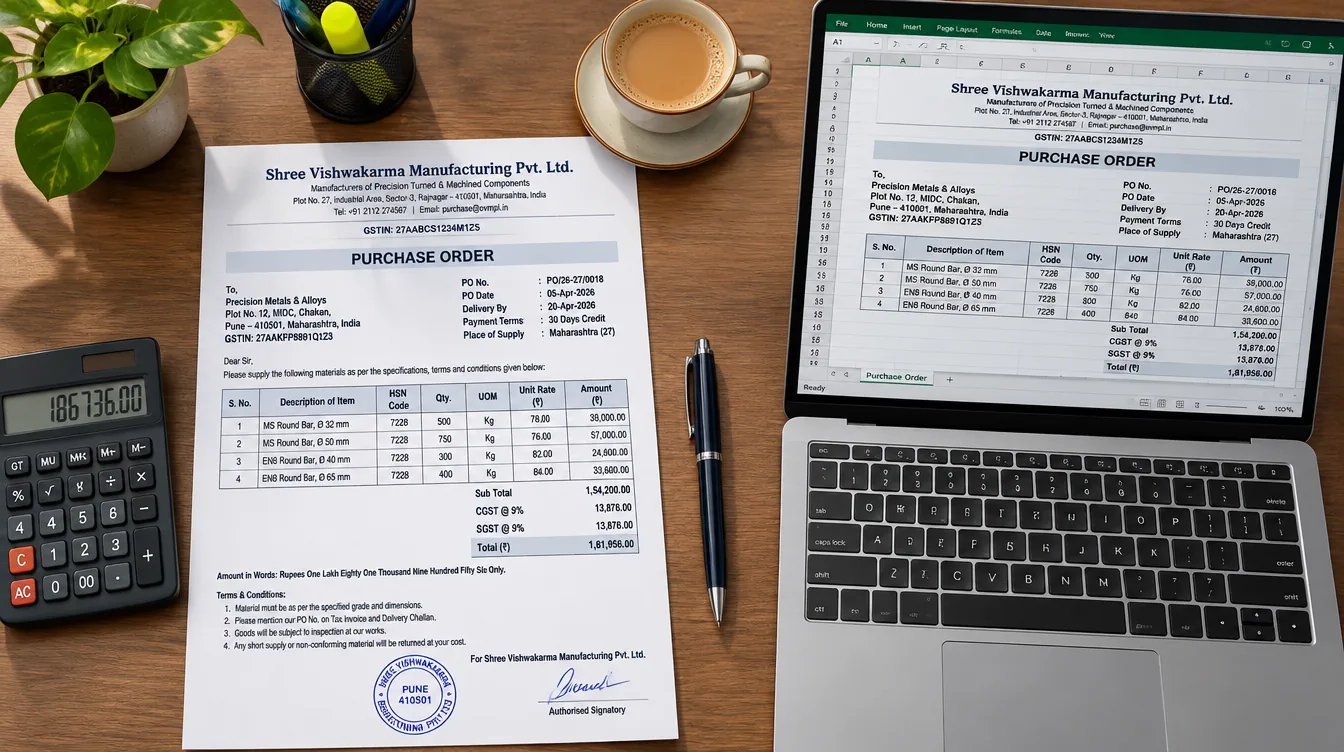
The sample formats below are also covered in the Excel file’s layout guidance. Word versions of each format are not yet available for download; if you need one, copy the table layout from the samples in this guide.
What is a purchase order?
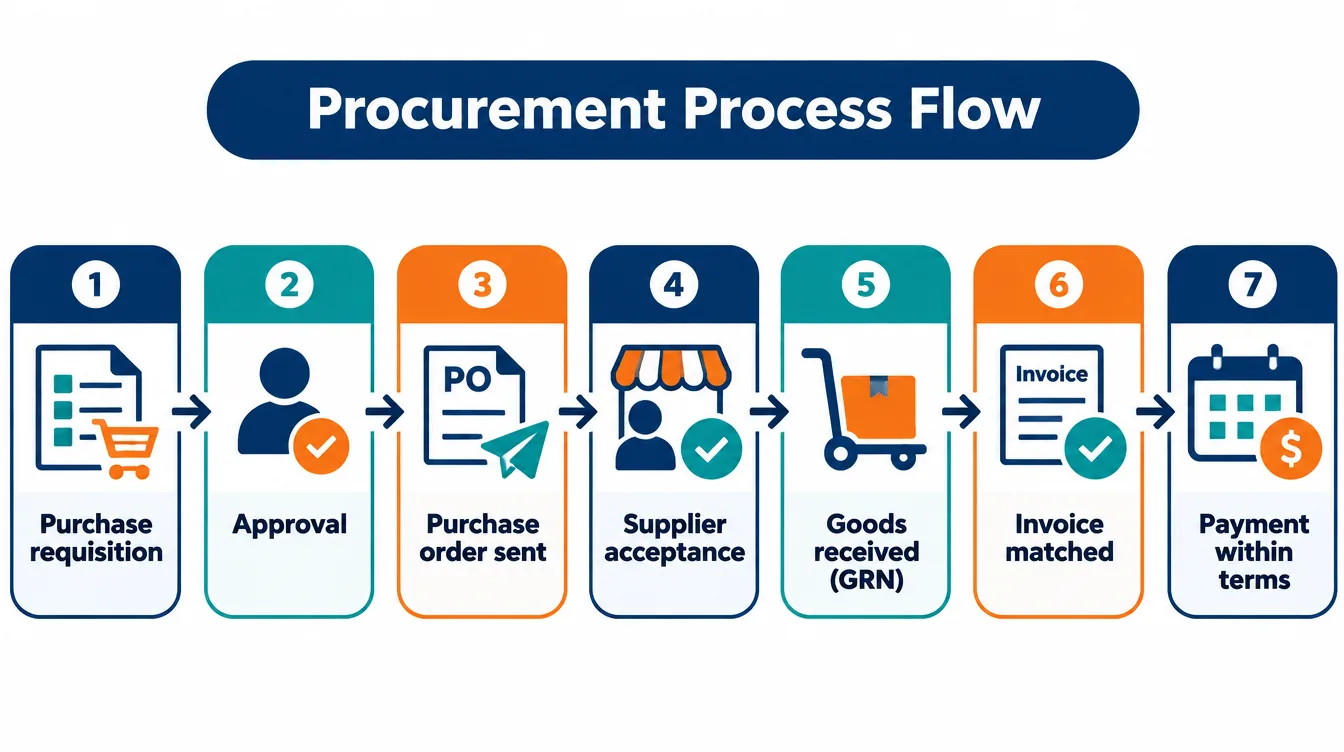
A purchase order (PO) is a written order from a buyer to a supplier that fixes what is being bought, the quantity, the price, the delivery date and the payment terms. It is usually issued after the buyer accepts the supplier’s quotation, and it comes before the supplier’s sales order, delivery and tax invoice.
Under the Indian Contract Act, 1872, a purchase order works as the buyer’s offer, and a binding contract forms when the supplier accepts it, either by signing or acknowledging it or by starting supply, as Forms Legal’s India PO guide explains. The acceptance has to match the PO’s terms.
That second point decides real disputes. In Padia Timber Company v. Visakhapatnam Port Trust (2021), the Supreme Court held that a conditional acceptance with a further condition is a counter-proposal, not a concluded contract, citing Section 7 of the Act (Cyril Amarchand Mangaldas blog).
So if the supplier replies “OK, but delivery in 30 days, not 15”, you do not yet have a deal on your PO terms.
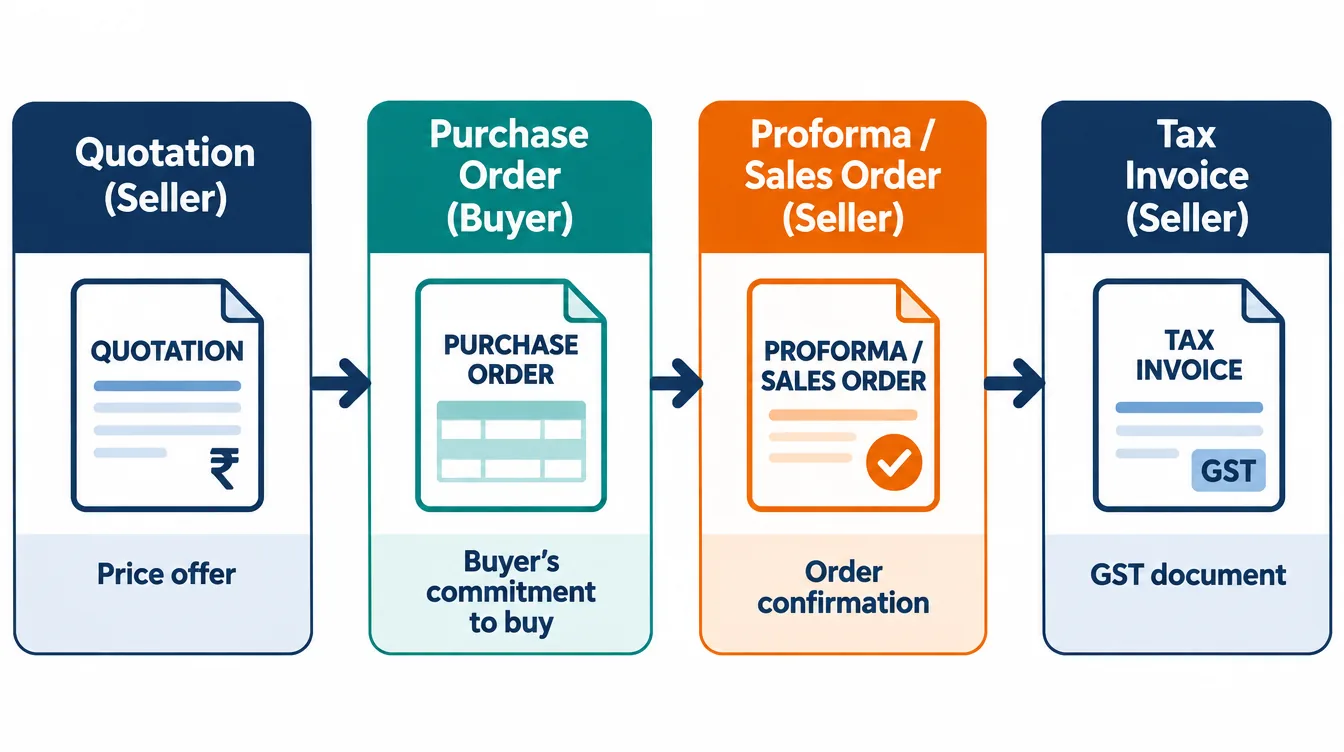
Here is how the purchase order fits between the other documents:
| Document | Issued by | When | What it does |
|---|---|---|---|
| Quotation | Supplier | Before the order | Price offer, valid for a fixed period |
| Purchase order | Buyer | After accepting the quote | Buyer’s commitment to buy on stated terms |
| Sales order or proforma invoice | Supplier | After receiving the PO | Confirms the supplier accepts the PO |
| Goods receipt note (GRN) | Buyer | When goods arrive | Records what was actually received |
| Tax invoice | Supplier | At or before supply | GST document; the buyer claims input tax credit on it |
If you are the supplier and need the offer that comes before the PO, see our quotation format.
What to include in a purchase order format
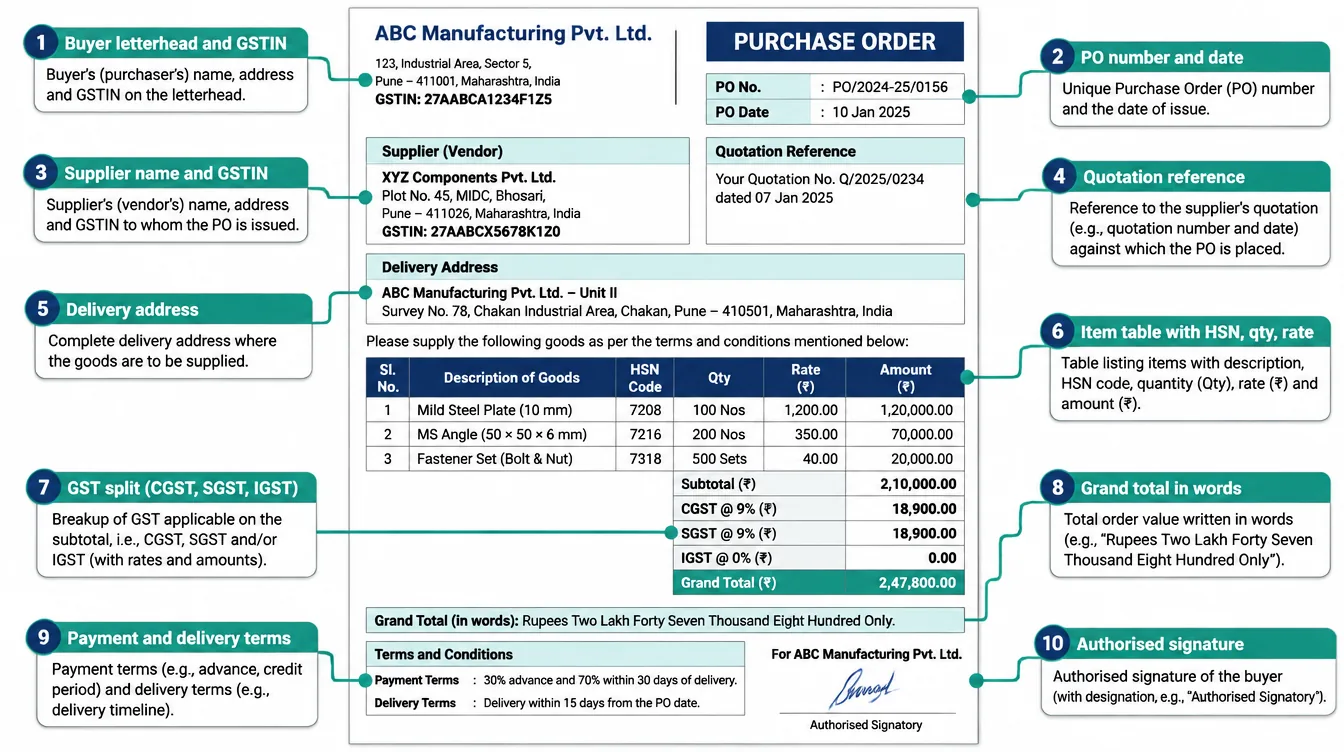
A complete purchase order format has 14 elements, from the buyer’s letterhead and GSTIN to the authorised signature. The ones that cause the most disputes later are the item specification, the delivery date and the payment terms.
| # | Element | Why it matters |
|---|---|---|
| 1 | Buyer letterhead: legal name, address, GSTIN, PAN, contact | Identifies who is buying and who will be billed |
| 2 | Title “PURCHASE ORDER” | Separates it from a quotation or an invoice |
| 3 | PO number and PO date | Unique and sequential (e.g. PO/26-27/0018); the supplier quotes it on the invoice |
| 4 | Supplier name, address, GSTIN, Udyam number | Udyam status decides your MSME payment deadline |
| 5 | Supplier’s quotation number and date | Ties the price to the agreed offer |
| 6 | Bill-to and ship-to address | The delivery state decides CGST plus SGST or IGST |
| 7 | Item table: description, specification, HSN/SAC, qty, unit, rate, discount | Removes doubt about grade, size, make and price |
| 8 | GST rate and amount per line | Shows the full landed cost and catches wrong rates early |
| 9 | Freight, packing, insurance, unloading | States who pays, so the invoice has no surprises |
| 10 | Total in figures and words | Prevents misreading and tampering |
| 11 | Delivery date or schedule and delivery basis | “Ex-works Pune” and “delivered at our plant” cost differently |
| 12 | Payment terms: advance, credit days, mode | Must respect the MSME 45-day limit for micro and small suppliers |
| 13 | Inspection, rejection, warranty and penalty clauses | Sets what happens if goods are wrong or late |
| 14 | Authorised signatory, seal and supplier acceptance line | Shows the PO was approved and accepted |
Ask the supplier for one thing before you issue the first PO: their Udyam registration certificate, or a written statement that they are not registered. It decides your payment deadline (see the 15-45-180 rule).
GST rules for a purchase order format in 2026
GST law prescribes what a supplier’s tax invoice must contain, not what a purchase order must contain, so a PO is not a GST document. As Everhour’s India PO guide notes, capturing the supplier GSTIN, HSN or SAC and expected GST treatment on the PO leaves accounts payable fewer gaps when the invoice arrives.
These are the five GST rules worth building into your GST purchase order format:
| # | Rule | What it means on your PO | Source |
|---|---|---|---|
| 1 | HSN digits by turnover | Supplier’s tax invoice needs a 4-digit HSN if their turnover was up to ₹5 crore, 6 digits above that; SAC code for services is 6 digits | Notification 78/2020-Central Tax |
| 2 | Place of supply | Supplier and delivery point in the same state: CGST + SGST. Different states: IGST | IGST Act place-of-supply rules |
| 3 | Current slabs | Main rates 5% and 18%, with 40% for luxury and sin goods; 12% and 28% removed | 56th GST Council, from 22 September 2025 |
| 4 | Reverse charge services | For notified services such as GTA freight and legal services, you pay the GST, not the supplier | Notification 13/2017-Central Tax (Rate), as amended |
| 5 | 180-day payment | Pay value plus GST within 180 days of the invoice, or reverse the input tax credit with interest | Section 16(2), CGST Act, read with Rule 37 |
Rules 1 and 2: match HSN codes and pick the right GST split
Write the same HSN code on the PO that you expect on the invoice, so the GST rate you budget is the rate you are billed. From 1 April 2021, Notification No. 78/2020-Central Tax requires 4-digit HSN codes on B2B invoices for businesses with turnover up to ₹5 crore and 6 digits above it.
For goods delivered to you, the place of supply is generally where the movement ends. So compare the supplier’s state with your ship-to state, not your head office state. A Pune factory buying from a Nashik supplier pays CGST plus SGST; the same factory buying from a Vapi supplier in Gujarat pays IGST.
Here is a worked example of a purchase order from a Pune manufacturer for steel (HSN 7208 and 7215 at 18%; confirm the rate for your exact item):
| Line | Qty | Rate | Amount |
|---|---|---|---|
| MS plate, IS 2062 E250, 10 mm | 2,000 kg | ₹62 | ₹1,24,000 |
| Bright bar, EN8, 25 mm round | 500 kg | ₹78 | ₹39,000 |
| Subtotal | ₹1,63,000 | ||
| Less: trade discount 2% | ₹3,260 | ||
| Taxable value | ₹1,59,740 | ||
| Supplier in Maharashtra: CGST 9% + SGST 9% | ₹14,376.60 + ₹14,376.60 | ||
| Supplier in Gujarat: IGST 18% | ₹28,753.20 | ||
| PO total (either case) | ₹1,88,493.20 |
The total is the same; only the tax lines change.
Rule 3: update old templates to the 2025 slabs
The GST Council moved to two main slabs of 5% and 18%, plus 40% for luxury and sin goods, from 22 September 2025, removing the 12% and 28% slabs (Business Standard). Many free PO templates online still validate GST at 12% and 28%. Delete those options from your Excel drop-down.
Rule 4: mark reverse charge purchases on the PO
When you buy a service notified for reverse charge, the supplier bills without GST and you pay the GST yourself. The main list sits in Notification No. 13/2017-Central Tax (Rate) and covers services such as goods transport agency (GTA) freight and legal services by advocates (Taxscan’s 2026 RCM list).
Add one line on such POs: “GST payable by the recipient under reverse charge.”
Rule 5: advances and the 180-day credit rule
A supplier of goods does not pay GST on an advance you give against a PO; GST arises at the invoice. That relief comes from Notification No. 66/2017-Central Tax and does not cover services, where advances stay taxable.
On your side, the clock starts at the invoice. Under the second proviso to Section 16(2) of the CGST Act and Rule 37, if you don’t pay the supplier the value plus GST within 180 days of the invoice date, you reverse the input tax credit with interest, and you can re-claim it after paying (TaxGuru).
The 15-45-180 rule for PO payment terms
The 15-45-180 rule is a simple way to set payment terms on any purchase order in India: pay a micro or small supplier within 15 days if nothing is agreed in writing, never agree more than 45 days with them, and pay every GST-registered supplier within 180 days of the invoice. Each number comes from a different law, and missing it costs money in a different way.
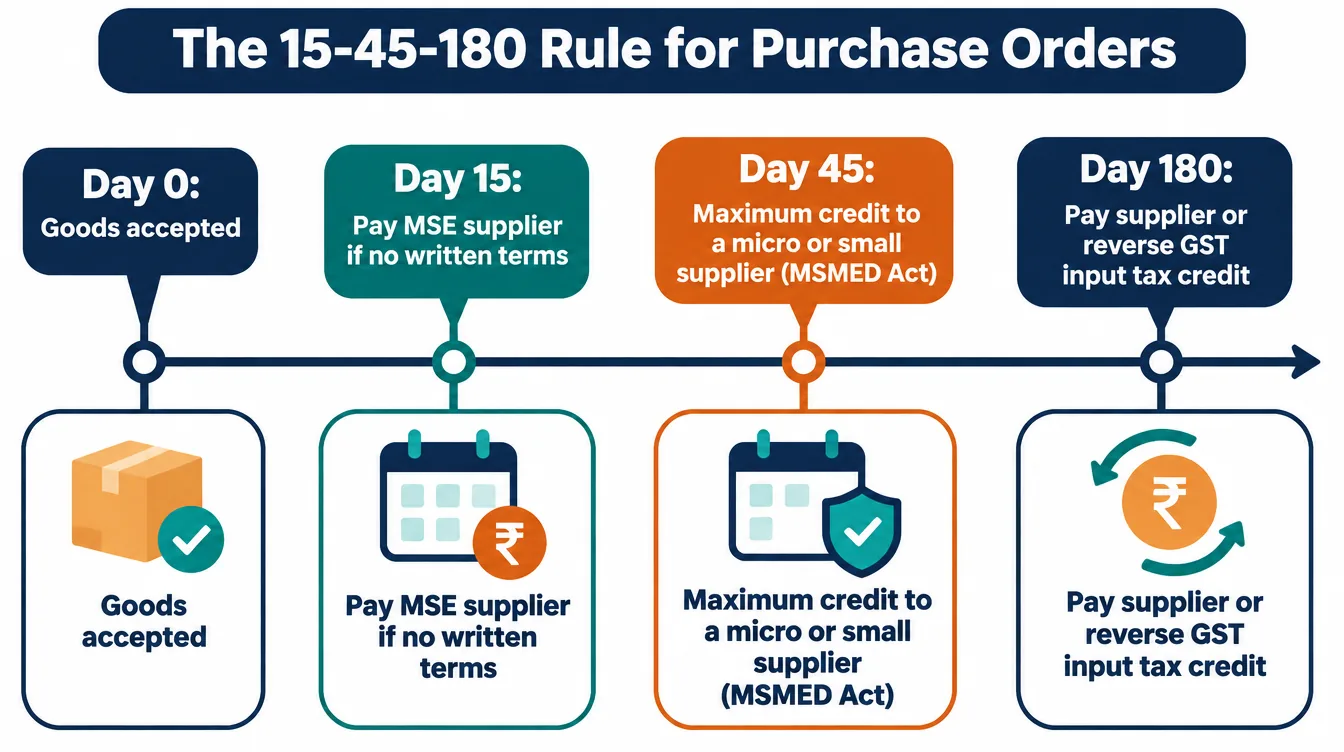
| Day | Applies to | Law | What happens if you miss it |
|---|---|---|---|
| 15 | Udyam-registered micro and small suppliers, no written payment terms | Section 15, MSMED Act, 2006 | Compound interest at 3x the RBI bank rate (Section 16); expense deduction pushed to the year you pay |
| 45 | Udyam-registered micro and small suppliers, written terms | Section 15, MSMED Act, 2006 | Same as above; terms longer than 45 days are capped at 45 |
| 180 | Every GST-registered supplier | Section 16(2), CGST Act, Rule 37 | Input tax credit reversed with interest until you pay |
Section 16 of the MSMED Act sets the delay interest at compound interest with monthly rests at three times the RBI bank rate (TaxGuru).
Why the 45-day limit belongs on your PO
If a micro or small supplier is not paid within the MSMED Act deadline, the buyer cannot deduct that expense until the year it is actually paid. That is Section 43B(h) of the Income-tax Act, 1961, and from 1 April 2026 the corresponding provision is Section 37(2)(g) of the Income-tax Act, 2025, as the Finance Ministry confirmed in a Rajya Sabha reply on 21 July 2026 (TaxGuru).
Unlike most Section 43B items, this one gets no relief for paying before the return due date, according to the same Busy guide. Delayed-payment interest under the MSMED Act is also not deductible.
A quick example: your factory accepts ₹1,88,493 of steel from a Udyam-registered small enterprise on 1 January 2027, on 45-day terms. Payment is due by 15 February 2027. If you pay on 10 April 2027, the expense moves out of tax year 2026-27 into tax year 2027-28, and the supplier can claim interest for the delay.
Two limits on who counts. The rule covers a micro and small enterprise only, not medium ones, and TaxGuru notes that traders registered on Udyam don’t get MSMED Act payment protection. Since 1 April 2025, a micro enterprise has investment up to ₹2.5 crore and turnover up to ₹10 crore, and a small enterprise up to ₹25 crore and ₹100 crore (MSME notification of 21 March 2025).
Companies also report it to the MCA
A company that owes a micro or small supplier for more than 45 days must file Form MSME-1, a half-yearly return to the Registrar of Companies, by 31 October (April to September) and 30 April (October to March). The due dates are listed by ClearTax. Under the MCA V3 portal, reporting also covers dues that were paid late, not only those still unpaid (Legalwiz).
The fix starts on the PO. Put the supplier’s Udyam number and the payment days on it, and your accounts team can see the deadline from day one.
TDS on purchases: Section 194Q is now Section 393
From 1 April 2026, TDS on purchase of goods moved from Section 194Q of the Income-tax Act, 1961 to Section 393(1), Table Sl. No. 8(ii), of the Income-tax Act, 2025, at the same 0.1% rate on purchases above ₹50 lakh from one resident seller in a year. That mapping is set out by TaxGuru’s TDS guide to the new Act and Busy.
Under Section 194Q, the buyer had to have turnover above ₹10 crore in the previous year, and Busy notes the rate rises to 5% if the seller gives no PAN. Your PO is the right place to collect the supplier’s PAN and to state that TDS will be deducted when applicable.
Worked example: you have bought ₹49,00,000 from one supplier so far this year. The next invoice has a taxable value of ₹1,59,740, so cumulative purchases reach ₹50,59,740. TDS applies only on the ₹59,740 above ₹50 lakh: 0.1% is about ₹60.
Busy also explains that when TDS is deducted at the time of credit and GST is shown separately, it may be deducted on the amount excluding GST. Update the section reference in your PO terms, ERP tax codes and challans from “194Q” to “Section 393”. Confirm the current buyer turnover condition under Section 393 with your CA before you rely on it.
How to make a purchase order format in Excel with auto GST
A purchase order format in Microsoft Excel can calculate every line amount, choose CGST plus SGST or IGST from the two GSTINs, and total the PO with five formulas. It takes about 10 minutes to set up once, and then you save it as a template.
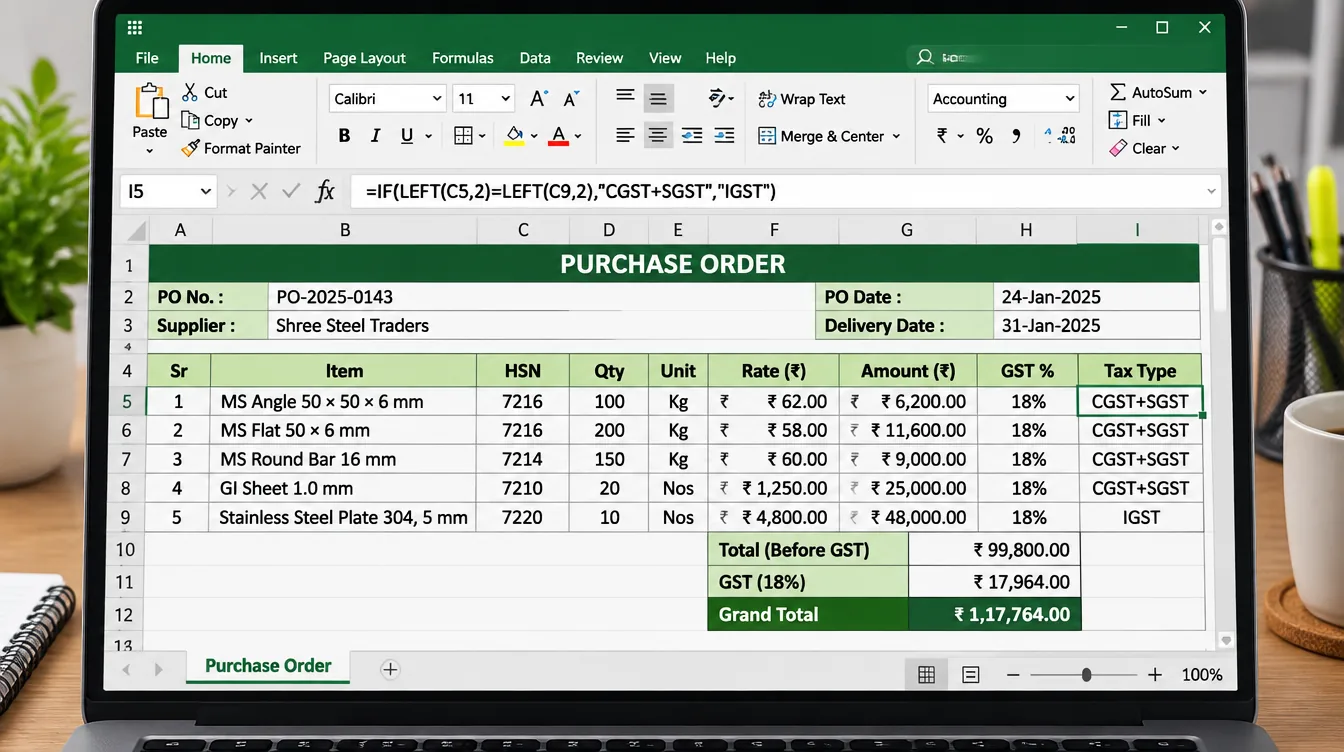
- Set up the header. In rows 1 to 4 type your company name, address, GSTIN and PAN. Put “PURCHASE ORDER” in bold, PO number in G2 and PO date in G3.
- Add supplier and ship-to blocks. Put the supplier’s GSTIN in C9 and your ship-to GSTIN (or the GSTIN of the receiving plant) in C5.
- Build the item table. From row 12, columns: A Sr, B Description, C HSN, D Qty, E Unit, F Rate, G Disc %, H Amount, I GST %. In H12 type
=D12*F12*(1-G12/100)and copy it down to row 21. - Restrict GST rates. Select I12:I21, go to Data > Data Validation > List, and enter
0,5,18,40. Old 12% and 28% rates can’t be typed by mistake. - Let Excel pick the tax type. In B23 type
=IF(LEFT(C5,2)=LEFT(C9,2),"CGST + SGST","IGST"). The first two characters of a GSTIN are the state code (27 is Maharashtra, 24 is Gujarat). - Calculate tax by rate. Taxable value in H22:
=SUM(H12:H21). Total GST in H23:=SUMPRODUCT(H12:H21,I12:I21)/100. If B23 says CGST + SGST, show half of H23 on each line; otherwise show H23 as IGST. - Total and protect. Grand total in H25:
=ROUND(H22+H23+H24,0), where H24 holds freight. Unlock the input cells, then Review > Protect Sheet, and save as an Excel template (.xltx).
Two cautions. The GSTIN shortcut works when goods are delivered to your registered place in that state; for a delivery to a site in another state, check the place of supply with your CA. And Excel can’t write Indian amounts in words (lakh, crore) without a macro, so type that line yourself.
Prefer Word? A purchase order format in Microsoft Word works for one-off or service POs with long terms. Use a table and Table Layout > Formula (for example =SUM(ABOVE)), then press Ctrl+A and F9 to refresh, as Microsoft’s guide to formulas in Word tables explains. For anything with many lines, Excel is safer.
8 purchase order format samples
Each format below is a starting layout. Replace the bracketed fields, add your letterhead and save as PDF.
1. Standard GST purchase order format (goods)
When to use: any GST-registered business buying goods. Use this if you are unsure.
- Buyer legal name, address, GSTIN and PAN; PO number and date; your quotation reference
- Supplier name, address, GSTIN, PAN and Udyam number (or “not registered”)
- Bill-to and ship-to addresses, and place of supply
- Item table: description and specification, HSN, qty, unit, rate, discount, GST % and amount; then taxable value, CGST/SGST or IGST, freight and PO total
- Amount in words, terms (delivery, prices, payment, invoice requirements, inspection, TDS, acceptance) and signature blocks for both parties
2. Simple purchase order format without GST
When to use: buyers not registered under GST, small cash purchases and internal orders where tax is not split.
- Business name and address; PO number and date; supplier name and address
- Item table with description, quantity, rate and amount, and a total inclusive of taxes
- Amount in words; delivery date and place; payment terms (cash on delivery or days); signature
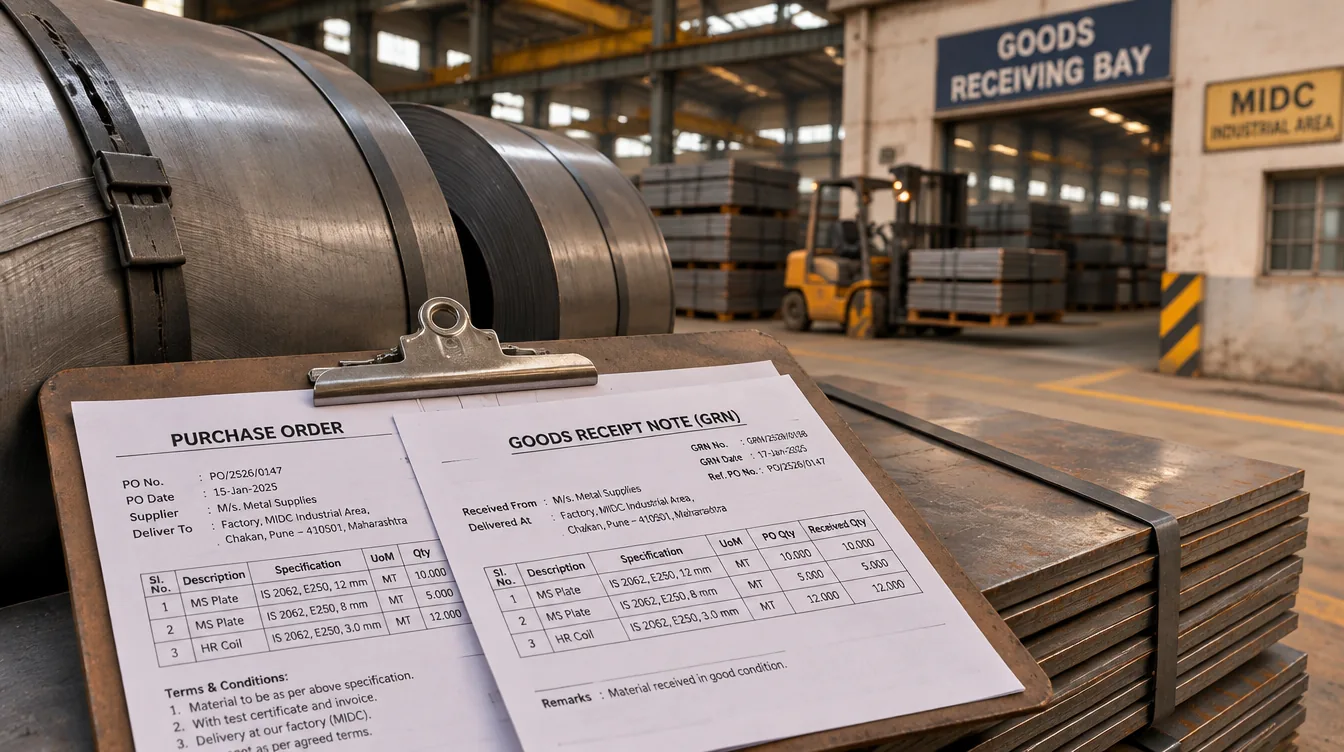
3. Raw material purchase order format (manufacturing)
When to use: factories, fabricators, foundries and job-work units buying steel, polymers, chemicals or bought-out parts against a specification.
- Item table with material, grade and standard, HSN, qty, unit, rate, GST, amount and delivery date
- Drawing or specification number and revision; price basis (delivered or ex-works); quantity tolerance
- Mill test certificate (MTC) with every lot; inspection window; late-delivery deduction; payment days (not more than 45 for Udyam-registered micro and small suppliers)
- Documents to come with the invoice: e-way bill where required, delivery challan, MTC and packing list
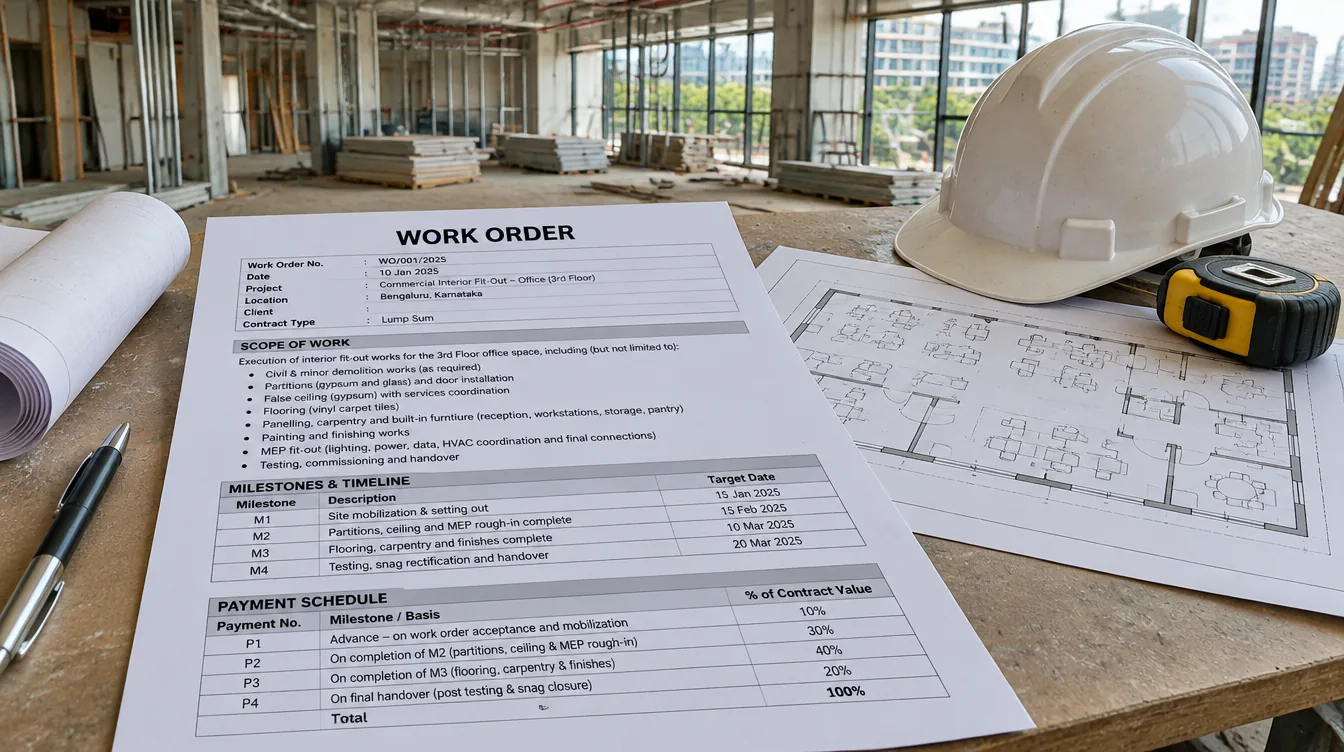
4. Service purchase order or work order format
When to use: contractors, AMC providers, repair and maintenance, transporters, interior fit-out and agencies, where scope matters more than unit rates. Many companies call this a work order.
- Scope of work and exclusions, in bullet points
- Service lines with SAC code and amount, then subtotal, GST and total
- Period or timeline; milestone payments; reverse charge status (applicable or not)
- Safety and compliance responsibilities; written approval needed before any extra work
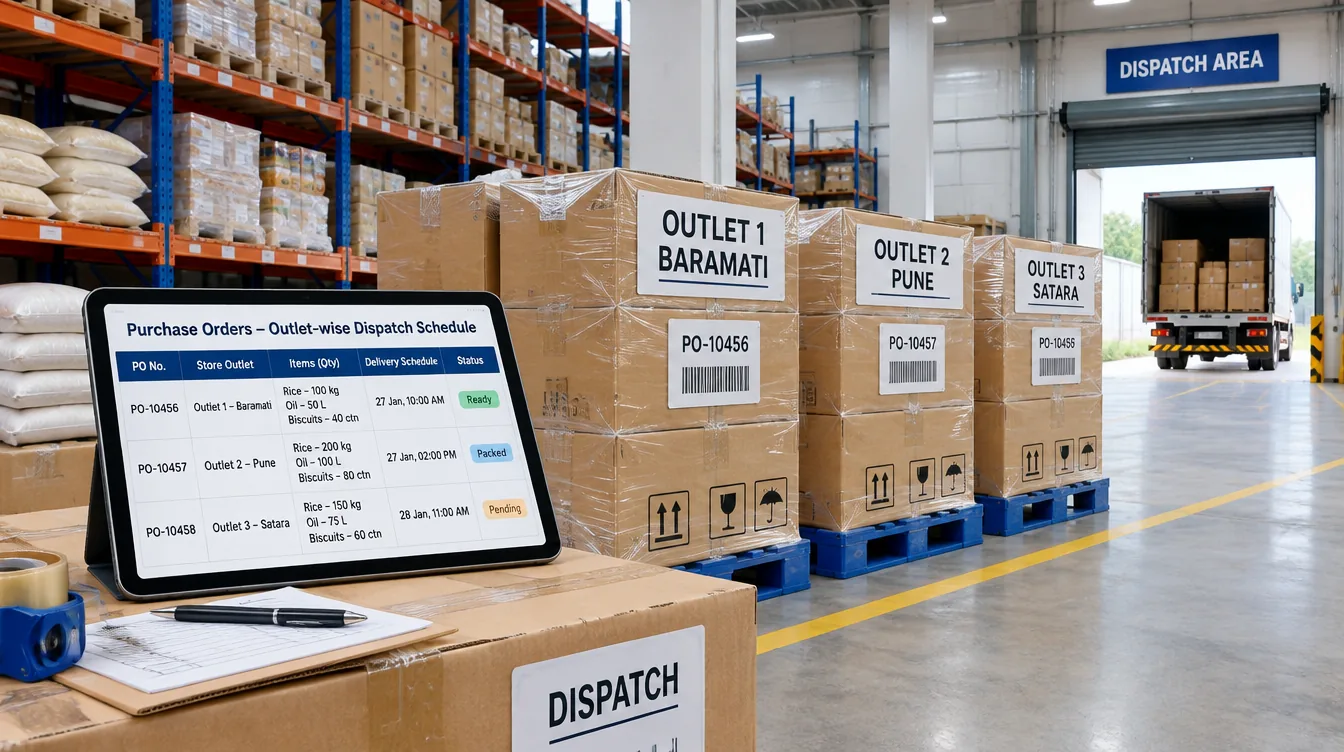
5. Multi-outlet retail purchase order format
When to use: retail chains, franchise groups and distributors ordering one lot for several stores, with outlet-wise delivery.
- Item table with SKU, HSN, MRP, rate, GST %, one quantity column per outlet, total quantity and amount
- Delivery schedule per outlet with address, GSTIN where the state differs, and delivery date
- Terms: a separate invoice and delivery challan per outlet, minimum shelf life on delivery, replacement window for short or damaged goods, and scheme terms
6. Blanket purchase order format (annual rate contract)
When to use: consumables, packaging, spares or services bought repeatedly at fixed rates, where you release quantities through call-off orders.
- Validity period; items with HSN, unit, agreed rate, GST %, estimated annual quantity and ceiling value
- Terms: the blanket order fixes rates only; quantities come through written release orders quoting its number; estimates are not a commitment to buy; either party may end it on notice
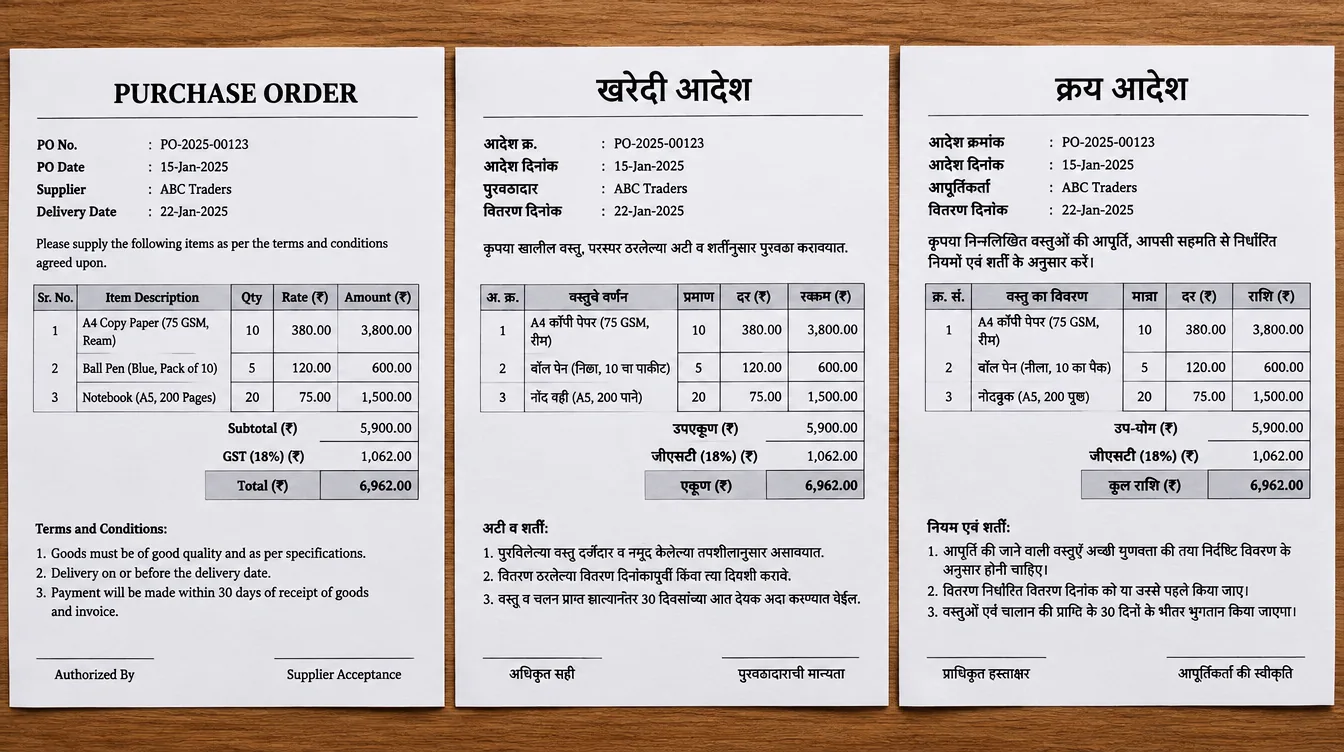
7. Purchase order format in Marathi (खरेदी आदेश)
When to use: suppliers, fabricators and traders in Maharashtra who prefer Marathi. Keep HSN codes, GSTIN and figures in English digits so they match the invoice.
The Marathi version carries the same fields as the standard format: order number and date, supplier details, the item table with GST and total, the amount in words, the terms, and a signature block. The terms cover delivery to the named address, GSTIN and HSN on the bill, payment within the agreed days (not more than 45 for micro and small enterprises), return of rejected goods at the supplier’s cost, and a signed acceptance copy.
8. Purchase order format in Hindi (क्रय आदेश)
When to use: Hindi-speaking suppliers and dealers across North and Central India.
The Hindi version carries the same fields as the standard format, with the same terms in Hindi: delivery to the named address by the agreed date, GSTIN and HSN on the bill, payment within the agreed days (not more than 45 for micro and small enterprises), return of rejected goods at the supplier’s cost, and a signed acceptance copy within 3 days.
PO format terms and conditions library
Good terms on a PO format answer the supplier’s next questions before they ask: when to deliver, what quality is acceptable, how invoices must look and when they will be paid. Copy the clauses you need.
- Acceptance: “Please sign and return a copy of this PO within [3] working days. Starting supply will be treated as acceptance of all terms of this PO.”
- Price: “Prices are firm and inclusive of packing. Freight, insurance and unloading are [included / extra at actuals, not exceeding ₹[ ]].”
- Delivery: “Delivery on or before [date] at [address], between [9 am and 5 pm], Monday to Saturday.”
- Late delivery: “Delays beyond the delivery date will attract a reduction of [0.5]% of the delayed value per week, up to [5]%.”
- Quality and inspection: “Goods will be inspected within [7] days of receipt. Rejected goods will be returned at the supplier’s cost and risk.”
- Invoice requirements: “Tax invoices must quote this PO number, our GSTIN, HSN or SAC codes and the place of supply. Invoices without a PO number may be held.”
- Payment (MSME-safe): “Payment within [30] days of acceptance of goods and receipt of a correct invoice. For Udyam-registered micro and small enterprises, payment will be made within the period allowed under Section 15 of the MSMED Act, 2006, not exceeding 45 days.”
- Taxes: “GST as applicable at the time of supply. TDS will be deducted where applicable under the Income-tax Act, 2025.”
- Reverse charge (services): “Where GST is payable by us under reverse charge, the supplier will not charge GST on the invoice.”
- Warranty: “[12] months from the date of acceptance against defects in material and workmanship.”
- Cancellation: “We may cancel undelivered quantities with [7] days’ written notice before dispatch.”
- Jurisdiction: “Subject to [City] jurisdiction.”
After the PO: the 3-way match
A 3-way match checks the purchase order, the goods receipt note and the supplier’s tax invoice against each other before payment, so you only pay for what you ordered, received and were correctly billed for. It is the control that makes a PO format worth the effort.
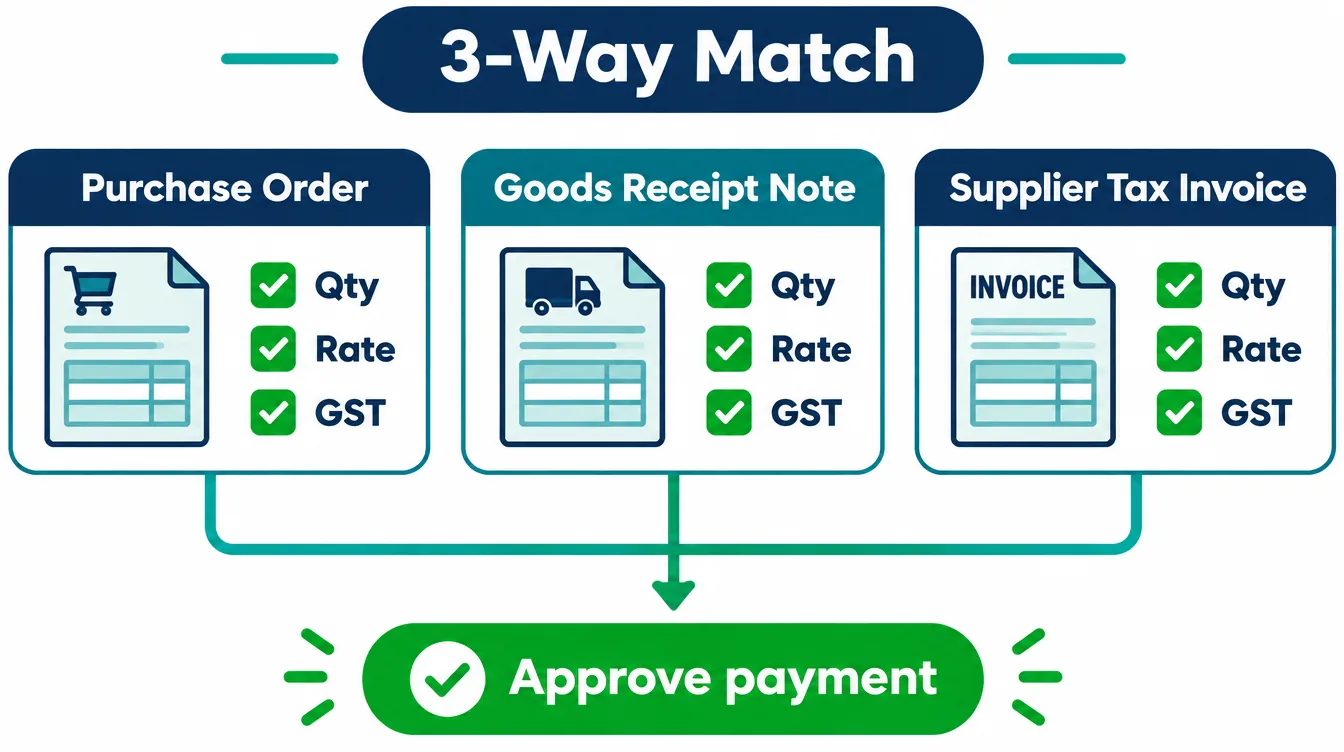
| Check | PO says | GRN says | Invoice says | Action if they differ |
|---|---|---|---|---|
| Quantity | 2,000 kg | 1,950 kg received | 2,000 kg billed | Pay for 1,950 kg; ask for a credit note |
| Rate | ₹62/kg | n/a | ₹64/kg | Hold; rate is fixed by the PO |
| GST | 18%, CGST + SGST | n/a | IGST billed | Ask for a corrected invoice; wrong tax type risks your ITC |
| PO number | PO/26-27/0018 | Quoted | Missing | Ask supplier to reissue with PO number |
| Due date | 45 days (MSE) | Accepted 1 Jan | Dated 30 Dec | Pay by 15 Feb; mark in payables |
Run the match before day 45 for micro and small suppliers, and before day 180 for everyone else. A disputed invoice still needs a written rejection or a credit note, or the payment clock keeps running.
Common purchase order format mistakes
Most PO problems come from a format copied from an old file: the old supplier’s GSTIN, last year’s rate, a GST slab that no longer exists or payment terms that break the MSME limit.
| Mistake | What happens | Fix |
|---|---|---|
| Order placed on WhatsApp, no PO | No proof of rate, grade or date in a dispute | Issue a numbered PO, even as a PDF on WhatsApp |
| No specification or grade | Wrong material delivered, rejected or argued over | Write grade, standard, size, make and drawing number |
| 60 or 90 days credit to a micro or small supplier | Interest claim, expense disallowed till paid, MSME-1 filing | Cap at 45 days; ask for Udyam status first |
| 12% or 28% GST still in the template | Budget mismatch and invoice disputes | Use 0, 5, 18 or 40% |
| Ship-to state ignored | Wrong GST type on invoice, ITC trouble | Compare supplier state with delivery state |
| Old “Section 194Q” wording | Wrong references in returns and ERP codes | Update to Section 393, Income-tax Act, 2025 |
| No supplier acceptance | PO terms not binding; counter-terms argued | Get signed acceptance or written confirmation |
| No PO number on the invoice | Invoice can’t be matched; payment delayed | Make it a PO term and reject invoices without it |
When spreadsheet POs stop working
A purchase order format in Word or Excel works until the same supplier rates, item codes and PO numbers have to be retyped for the GRN, the invoice check and the payment reminder. Each retype is a chance for a wrong rate, and nobody sees which POs are overdue for delivery or payment.
Mera Udyog is built for manufacturing units and multi-outlet retail chains. If your team handles more quotations, POs and orders than a spreadsheet can track, you can book a free demo to see how it fits your process.
Looking for other business formats? See all our free business templates, including the appointment letter format.
FAQ: purchase order format
What is the format of a purchase order?
A purchase order format has the buyer’s letterhead with GSTIN, the title “Purchase Order”, a unique PO number and date, the supplier’s name, GSTIN and quotation reference, bill-to and ship-to addresses, an item table with HSN or SAC, quantity, rate, discount and GST, the total in figures and words, delivery and payment terms, and an authorised signature.
How do I make a purchase order format in Excel?
Create an item table with Qty, Rate and Discount columns and use =D12*F12*(1-G12/100) for each line. Total with =SUM, calculate GST with =SUMPRODUCT of amount and rate divided by 100, and use =IF(LEFT(buyer GSTIN,2)=LEFT(supplier GSTIN,2),"CGST + SGST","IGST") to pick the tax type. Save it as an .xltx template.
Is a purchase order mandatory under GST?
No. GST law requires the supplier to issue a tax invoice, not the buyer to issue a purchase order. A PO is still the best proof of the agreed rate, quantity and terms, and it helps you match the invoice before claiming input tax credit.
Is a purchase order legally binding in India?
A purchase order becomes a binding contract once the supplier accepts it without changes, by signing or acknowledging it or by starting supply. Under Section 7 of the Indian Contract Act, 1872, an acceptance that adds new conditions is a counter-proposal, not an acceptance.
What payment terms can I put on a purchase order for an MSME supplier?
For a Udyam-registered micro or small enterprise, payment must be made within the agreed period, which cannot exceed 45 days from acceptance of goods or services, or within 15 days if nothing is agreed in writing. Late payment attracts interest under the MSMED Act and delays your income tax deduction.
What is the difference between a purchase order and an invoice?
The buyer issues a purchase order before supply to order goods on stated terms. The supplier issues a tax invoice at or before supply to bill for them, and the invoice is the GST document on which the buyer claims input tax credit.
Which section replaced Section 194Q from April 2026?
From 1 April 2026, TDS on purchase of goods falls under Section 393(1), Table Sl. No. 8(ii), of the Income-tax Act, 2025. The rate stays 0.1% on purchases above ₹50 lakh from one resident seller in the year.
Can I download a purchase order format in Word and Excel for free?
The Excel template on this page is free, with GST formulas included. Word versions of the sample formats are not yet available for download.
Sources
- Notification No. 78/2020-Central Tax: HSN digits on tax invoices, CBIC / GST Council, October 2020
- GST Council adopts two-rate structure; new rates from September 22, Business Standard, September 2025
- No GST on advance for goods: Notification 66/2017-Central Tax, TaxGuru
- 180-day ITC condition under Section 16(2) and Rule 37, TaxGuru, 2026
- List of services covered under RCM in GST 2026, Taxscan, 2026
- Section 43B(h): MSME payment rule and 45-day limit explained, Busy, August 2026
- Finance Ministry Rajya Sabha reply on Section 43B(h) and Section 37(2)(g), TaxGuru, July 2026
- Section 43B(h) and MSME classification considerations, TaxGuru, 2025
- MSME classification notification S.O. 1364(E), 21 March 2025, TaxGuru
- TDS under the Income-tax Act, 2025: section mapping, TaxGuru, 2026
- TDS Section 194Q and Section 393: high-value purchases, Busy, 2026
- Form MSME-1 due dates, ClearTax
- MSME Form 1: applicability and V3 portal changes, Legalwiz
- Supreme Court on conditional acceptance (Padia Timber, 2021), Cyril Amarchand Mangaldas, February 2021
- Purchase Order (India): legal framework, Forms Legal, 2026
- Purchase order template for India: GST details, Everhour
- Use a formula in a Word table, Microsoft Support
- MSMED Act delayed payment: 45 days and interest at 3x bank rate, TaxGuru, 2026
This page is general information, not legal or tax advice. Confirm HSN codes, GST rates, TDS applicability and MSME terms with your CA or legal adviser.