By Mera Udyog Team · Last updated: November 2, 2026
Your factory gets enquiries every day. Calls, IndiaMART leads, WhatsApp messages, walk-in dealers.
But ask your team which enquiries got a quotation, which quotations became orders, and which orders are still unpaid, and you get three different Excel sheets and a shrug.
That is exactly the problem a CRM for manufacturing industry solves.
In this guide, you’ll see:
- The 7 places where manufacturing sales quietly leak (and how a CRM plugs each one)
- 9 features a factory CRM must have, plus 6 tools compared with INR prices
- What a CRM really costs for 10, 25 and 50 users
A CRM for manufacturing industry is software that tracks every buyer, dealer and distributor enquiry from first call to final payment. It records calls, quotations, sales orders, dispatch and payment follow-ups in one place, so owners can see which enquiries turn into orders, which plant or branch is handling them, and which payments are overdue.
Quick answer: CRM for manufacturing industry (November 2026)
- A manufacturing CRM tracks the full enquiry-to-payment cycle: calls, quotations, sales orders, dispatch and collections.
- IndiaMART delivered 27 million unique business enquiries in the quarter ended September 30, 2026, so lead capture is the first feature to check.
- Pure CRMs like Bigin by Zoho (₹720 per user per month, Premier, annual) and Freshsales (₹749, Growth, annual) suit small sales-only teams.
- Mera Udyog costs ₹89,990 a year plus GST for up to 50 users and adds attendance, payroll, GST billing and inventory to the CRM.
- For 25 users, per-user CRMs in this guide cost roughly ₹2.16 lakh to ₹4.2 lakh a year before GST.
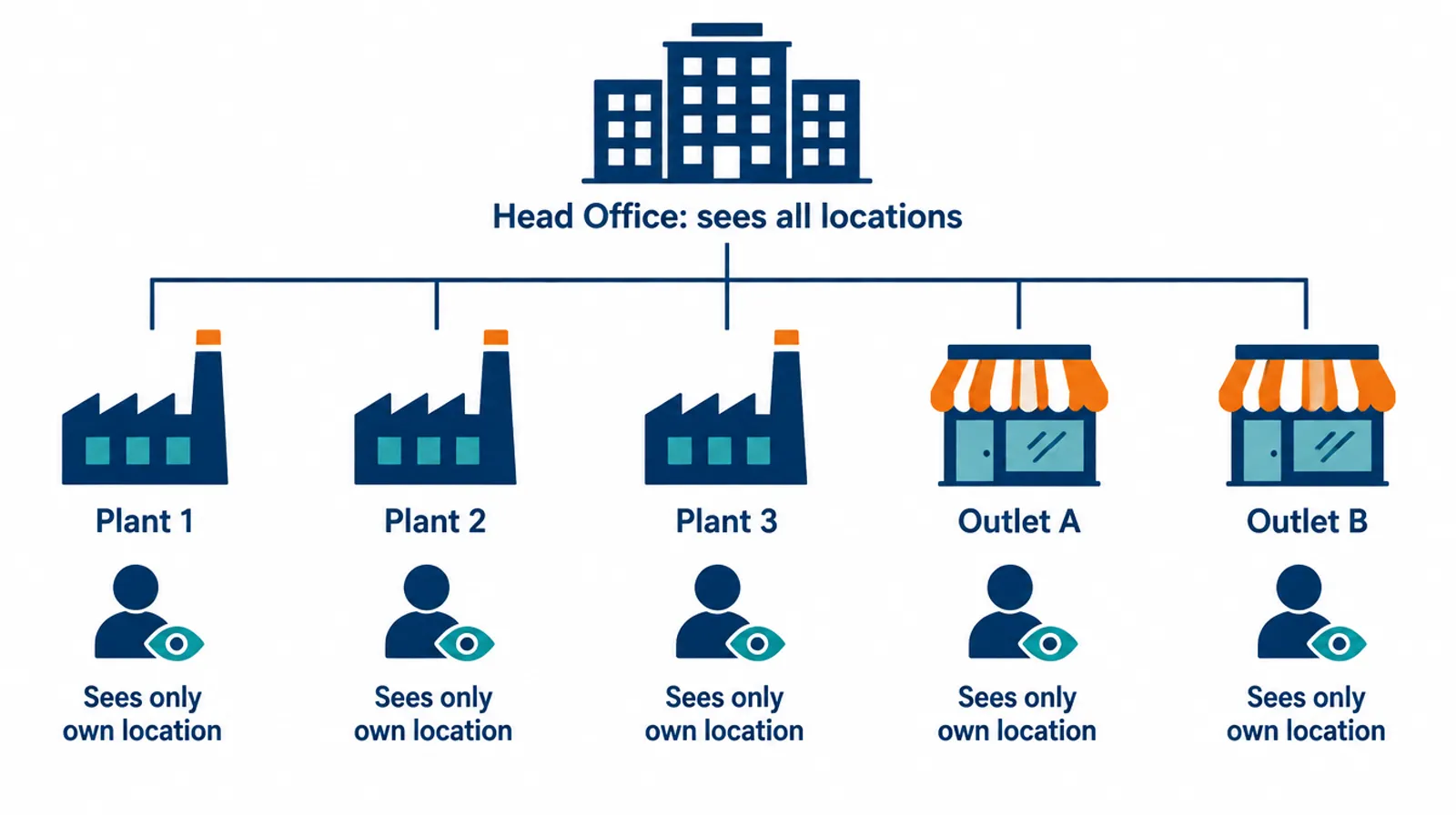
- Multi-plant and multi-outlet businesses should insist on branch-wise access, where each manager sees only their own location.
What Is CRM for Manufacturing Industry?
CRM for manufacturing industry is a sales and customer system built around how factories actually sell: through repeat B2B buyers, dealers and distributors, with quotations, sales orders and dispatch in the middle. A generic CRM for small business tracks leads and deals. A manufacturing CRM also has to handle the order and payment side.
Here’s the difference at a glance:
| What you need to track | Generic small business CRM | CRM for manufacturing industry |
|---|---|---|
| Who the customer is | Individual leads | Buyers, dealers, distributors, project sites |
| How deals close | One sale, one payment | Quotation, revisions, PO, sales order, part dispatches |
| Where enquiries come from | Website, ads | Calls, IndiaMART, trade fairs, dealer referrals, QR codes |
| Who handles the deal | One salesperson | Sales team plus plant, dispatch and accounts |
| Repeat business | Occasional | Monthly or seasonal reorders |
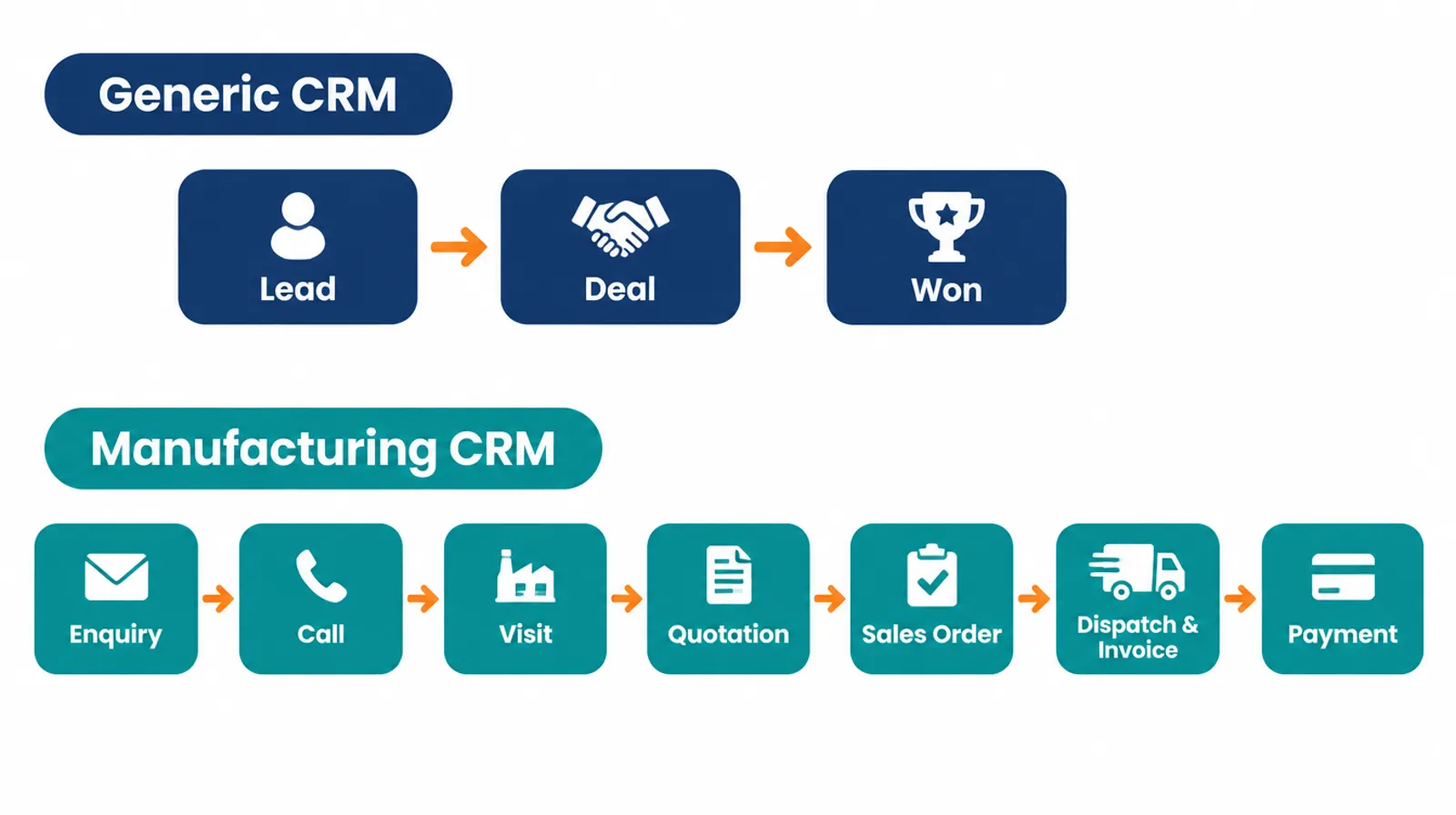
Bottom line: if your sale involves a quotation, a sales order and a payment follow-up, you need a CRM that understands all three, not just a lead list.
If you are still comparing general-purpose tools, our best CRM software in India comparison covers 10 options for every type of business.
Why Small Manufacturers Lose Orders Without a CRM
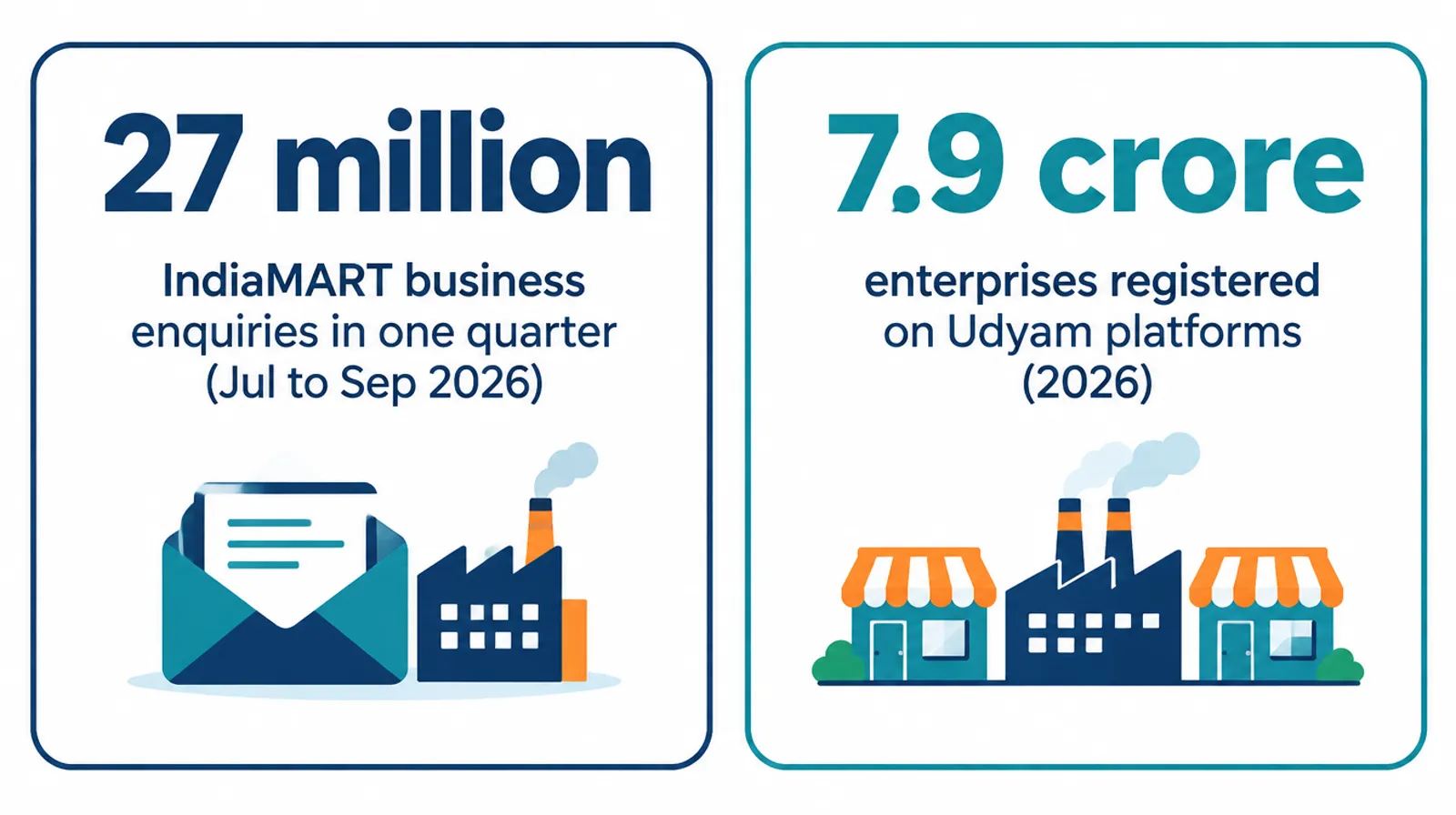
Small manufacturers lose orders mainly because enquiries arrive from too many channels and nobody owns the follow-up. The volume is real: IndiaMART reported 27 million unique business enquiries delivered in the quarter ended September 30, 2026, with 8.9 million supplier storefronts on the platform.
That is a lot of enquiries spread across a lot of suppliers.
Most of the businesses receiving them are small MSME units. Over 7.9 crore MSMEs and informal micro enterprises have registered on the Udyam and Udyam Assist platforms, according to a government statement reported by IANS in May 2026.
So what goes wrong?
- The enquiry sits in one salesperson’s phone. If they leave, the buyer history leaves with them.
- Quotations live in email and WhatsApp. Nobody knows which version the buyer approved.
- Follow-ups depend on memory. A buyer who said “call me after Diwali” never gets that call.
- Accounts chases payments blind. They don’t know what sales promised on credit terms.
Is a CRM worth the money? An older but widely cited Nucleus Research analysis (2014) found CRM paid back an average of $8.71 for every dollar spent, up from $5.60 in 2011. Treat that as directional, since it is based on Nucleus’s own case studies and is now over a decade old.
The Enquiry-to-Payment Map: 7 Stages Where Manufacturing Sales Leak
The Enquiry-to-Payment Map is a 7-stage model of how a small Indian manufacturer turns an enquiry into cash, with the most common leak at each stage. Use it to check whether a CRM covers your whole cycle or only the first two stages.
| Stage | What happens | Common leak | What the CRM should do |
|---|---|---|---|
| 1. Enquiry | Call, IndiaMART lead, dealer referral, QR scan | Enquiry never recorded | Capture every source into one list with an owner |
| 2. First call | Salesperson qualifies the buyer | Call not made for 2 to 3 days | Track calls made, talk time and untouched leads |
| 3. Sample or site visit | Sample sent, plant visit, site measurement | No reminder after the visit | Schedule the next step with a date |
| 4. Quotation | Price, GST, freight, credit terms | Wrong version sent, quote forgotten | Create quotes inside the CRM, keep revisions |
| 5. Sales order | PO received, order confirmed | Order not passed to the right plant | Convert quote to sales order and route it |
| 6. Dispatch and invoice | Goods leave, GST invoice raised | Sales doesn’t know what was dispatched | Link the order to billing and stock |
| 7. Payment | Collection against credit terms | Overdue payments noticed late | Show paid, due and overdue status per buyer |
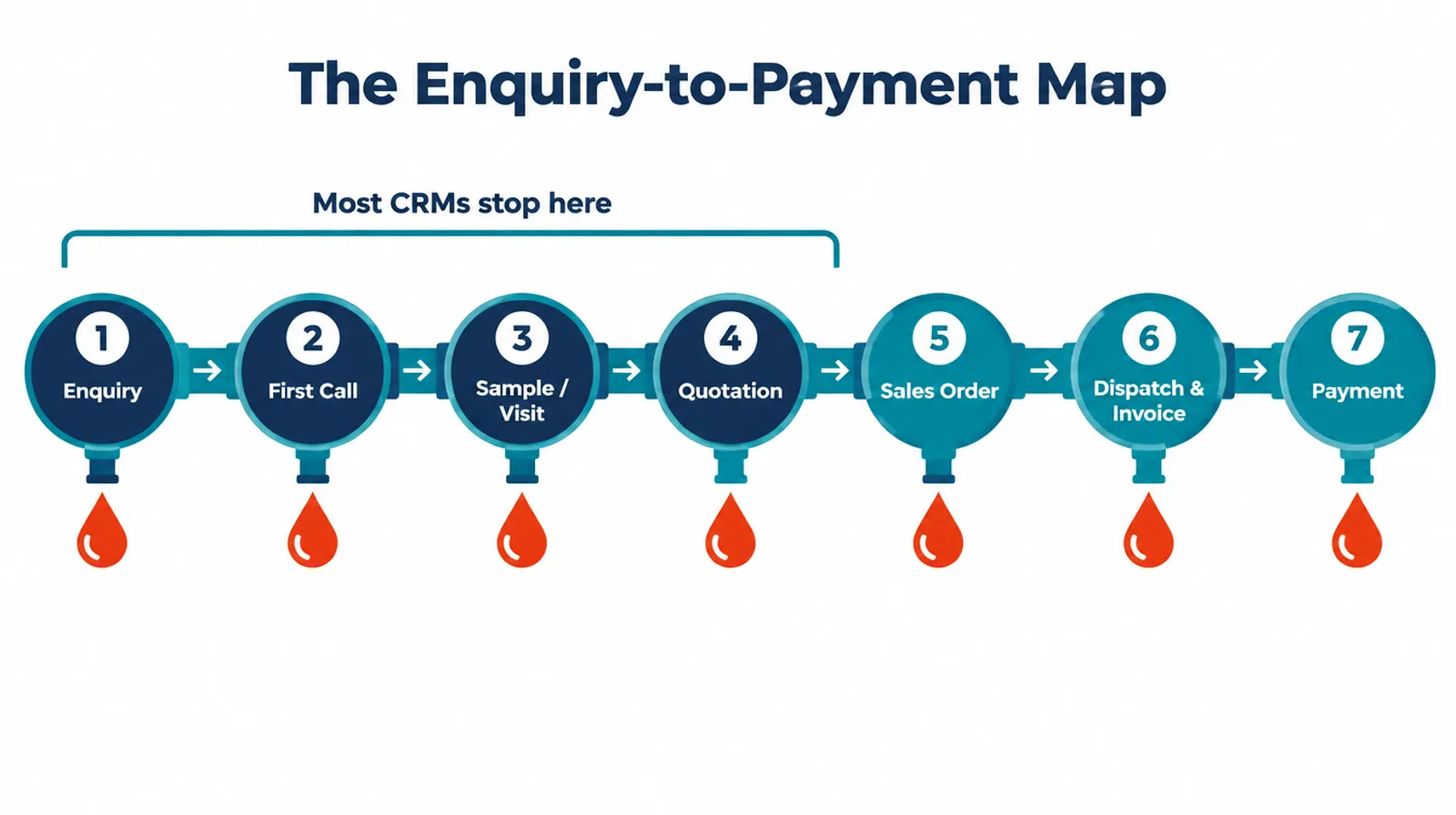
Notice the pattern. Stages 1 to 4 are classic CRM territory. Stages 5 to 7 are where many lightweight sales CRMs stop, and where manufacturers lose the most money.
Pro tip
Before any demo, print this table and tick each stage the tool covers on screen, not in the brochure. If a stage needs a second software, write its cost next to it.
9 Must-Have Features in Manufacturing CRM Software
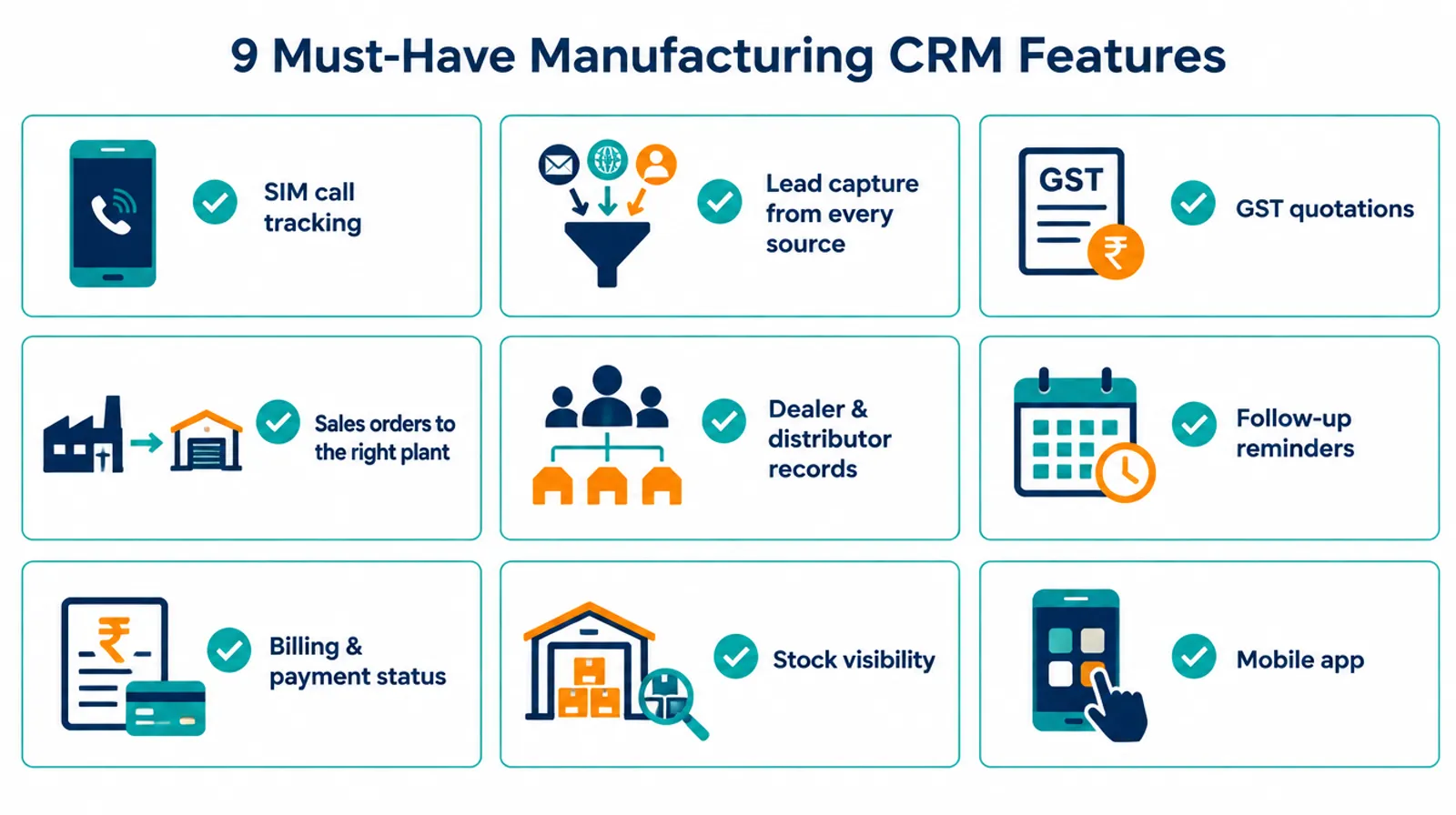
Manufacturing CRM software needs nine core features to cover the full enquiry-to-payment cycle: call tracking, multi-source lead capture, quotations, sales orders, branch routing, dealer records, follow-up reminders, billing and payment status, and mobile access. Here is what each one means in a small Indian factory.
1. Call tracking from your team’s own phones
Most factory sales still happen on the phone. A manufacturing CRM should record which salesperson called which buyer, for how long, and which leads nobody has called yet.
There are two ways tools do this. SIM-based calling tracks calls made from the salesperson’s own mobile SIM, so there’s no new number for buyers to learn. Cloud telephony routes calls through a virtual number you rent, which adds a monthly cost but suits call-centre style teams.
For example, Mera Udyog’s sales CRM tracks calls made from employees’ own SIMs and shows call counts, talk time and missed follow-ups per person.
2. Lead capture from every source
Factory enquiries come from IndiaMART, TradeIndia, your website, trade fairs, dealer referrals and walk-ins. The CRM should pull all of them into one list and assign an owner automatically.
Some tools connect natively; others need a script. Zoho CRM users, for instance, have shared a community-built script that pulls IndiaMART leads through IndiaMART’s API roughly every two hours. That works, but someone has to maintain it.
Mera Udyog lets enquiries come in from QR codes and links, which works well for trade fair stalls and printed catalogues.
3. Quotations with GST and revisions
Quotations decide most B2B orders. The CRM should build a quote with product, rate, GST, freight and payment terms, and keep every revision linked to the buyer.
Why? Because “which price did we send in the second quote?” is the question that kills deals on the negotiation call.
4. Sales orders that reach the right plant
A confirmed quote should turn into a sales order with one click. If you run more than one plant or warehouse, the order must route to the location that will make or ship it.
Mera Udyog runs KYC, quotations and sales orders in one flow and routes confirmed orders to the right branch or plant (Mera Udyog).
5. Dealer and distributor records
Many manufacturers sell through dealers and distributors, not end buyers. The CRM should store each partner’s territory, credit terms, order history and outstanding balance in one record.
Dealer-heavy businesses with large field teams often look at dedicated tools. LeadSquared’s manufacturing CRM, for example, focuses on dealer onboarding with KYC, beat plans and geo-fenced visit tracking.
6. Follow-up reminders and field visits
Every enquiry needs a next step with a date. The CRM should remind the salesperson, and show the owner which follow-ups are overdue across the team.
For field sales teams, add visit logging: who visited which dealer, when, and what was discussed.
7. GST billing and payment status
A manufacturing CRM that cannot see billing leaves your sales team blind on collections. At minimum, sales should see whether an order is invoiced and whether payment is paid, due or overdue.
Mera Udyog includes GST billing inside the same app, with paid, due and overdue tracking.
8. Stock visibility at the time of quoting
Promising a delivery date you can’t meet is the fastest way to lose a repeat buyer. The CRM should show stock per warehouse or outlet, or connect cleanly to the system that does.
See our guide to multi-location inventory management if you hold stock in more than one place.
9. Mobile access that shop-floor teams will use
Sales staff, supervisors and dispatch teams live on their phones. If the CRM only works well on a laptop, data entry stops within weeks.
Note
Test the mobile app on the cheapest phone your team actually uses, not on the owner’s flagship.
Best CRM for Manufacturing Industry in India: 6 Options Compared
The best CRM for manufacturing companies depends on team size and how much of the enquiry-to-payment cycle you want in one system. Pure sales CRMs are cheaper per user for small teams; all-in-one platforms cost more upfront but replace billing, attendance and stock tools.
Disclosure: Mera Udyog is our own product. Prices below are listed before 18% GST, on annual billing, and were checked in November 2026. Confirm on each vendor’s site before buying.
| Tool | Best for | Starting price (INR) | Free option | Covers stages (of 7) |
|---|---|---|---|---|
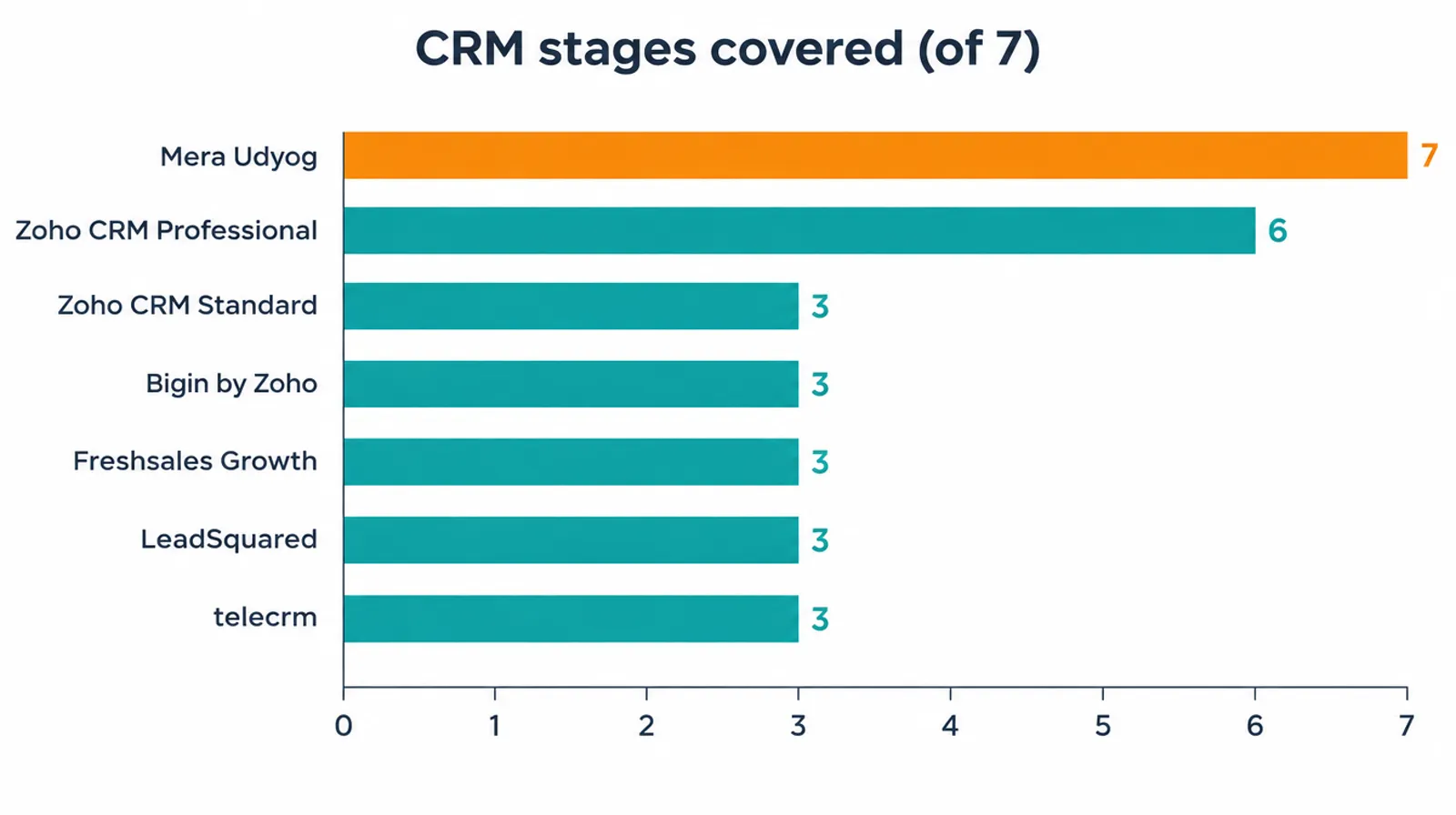
| Mera Udyog | Manufacturers and multi-outlet teams of 20 to 500 people wanting CRM, billing, attendance and stock in one app | ₹9,999/month or ₹89,990/year for up to 50 users | 7-day trial | 1 to 7 |
| Zoho CRM | Teams that want deep customisation | ₹800/user/month (Standard) | Free for up to 3 users | 1 to 3 (Standard); up to 6 on Professional |
| Bigin by Zoho | Very small teams wanting a simple pipeline | ₹400/user/month (Express) | Free edition | 1 to 3 |
| Freshsales | Small sales teams wanting AI lead scoring | ₹749/user/month (Growth) | Free plan | 1 to 3 |
| LeadSquared | Dealer-heavy businesses with field teams | From ₹1,250/user/month | Demo | 1 to 3, plus dealer and field modules |
| telecrm | Calling-heavy teams | ₹799/user/month | Demo | 1 to 3 |
Stage coverage is our reading of each vendor’s publicly listed features on the plan shown. Higher plans, add-ons and integrations can extend it, so confirm in a demo.
Mera Udyog
Mera Udyog is an all-in-one business app for Indian manufacturers and multi-outlet retailers with roughly 20 to 500 people. It combines a SIM-based telecalling CRM with GST billing, inventory, attendance and payroll, and branch-wise access.
- Price: ₹9,999 a month plus GST for up to 50 users, or ₹89,990 a year plus GST (Mera Udyog pricing).
- Strength: No per-module charges, and head office sees all plants while each manager sees only their own.
- Watch out: Statutory payroll follows Maharashtra rules only, and the mobile app is on Google Play.
Zoho CRM
Zoho CRM is a highly customisable CRM with a free plan for up to 3 users. The Standard plan costs ₹800 per user per month on annual billing, and Professional costs ₹1,400 (IT for SME, Zoho partner pricing page).
- Strength: Huge integration library, and the Professional edition adds inventory management with quotes, sales orders and invoices (Zoho CRM Professional).
- Watch out: You will likely need a partner or in-house admin to set it up for factory workflows.
Bigin by Zoho
Bigin is Zoho’s lightweight pipeline CRM. Paid plans start at ₹400 per user per month (Express), with Premier at ₹720 and Bigin 360 at ₹1,080, all billed annually (Bigin official pricing clarification).
- Strength: The cheapest paid entry point in this list, with a free edition.
- Watch out: Built for simple pipelines, so orders, billing and stock live elsewhere.
Freshsales
Freshsales from Freshworks offers a free plan, then Growth at ₹749 per user per month on annual billing and Pro at ₹3,239 (Freshworks reseller pricing page).
- Strength: AI lead scoring and a built-in phone option.
- Watch out: The jump from Growth to Pro is large if you need advanced features.
LeadSquared
LeadSquared positions itself as a manufacturing CRM for dealer and distributor management, with plans starting at ₹1,250 per user per month according to its own FAQ (LeadSquared).
- Strength: Dealer onboarding, beat plans and field visit tracking.
- Watch out: Pricing beyond the starting plan needs a sales call.
telecrm
telecrm is a calling-first CRM priced at ₹799 per user per month billed annually, or ₹1,099 billed quarterly (telecrm pricing).
- Strength: 1-click dialer and call recording.
- Watch out: WhatsApp is an add-on: ₹1,999 one-time setup plus ₹200 per user per month for chat sync.
What a CRM Costs at 10, 25 and 50 Users
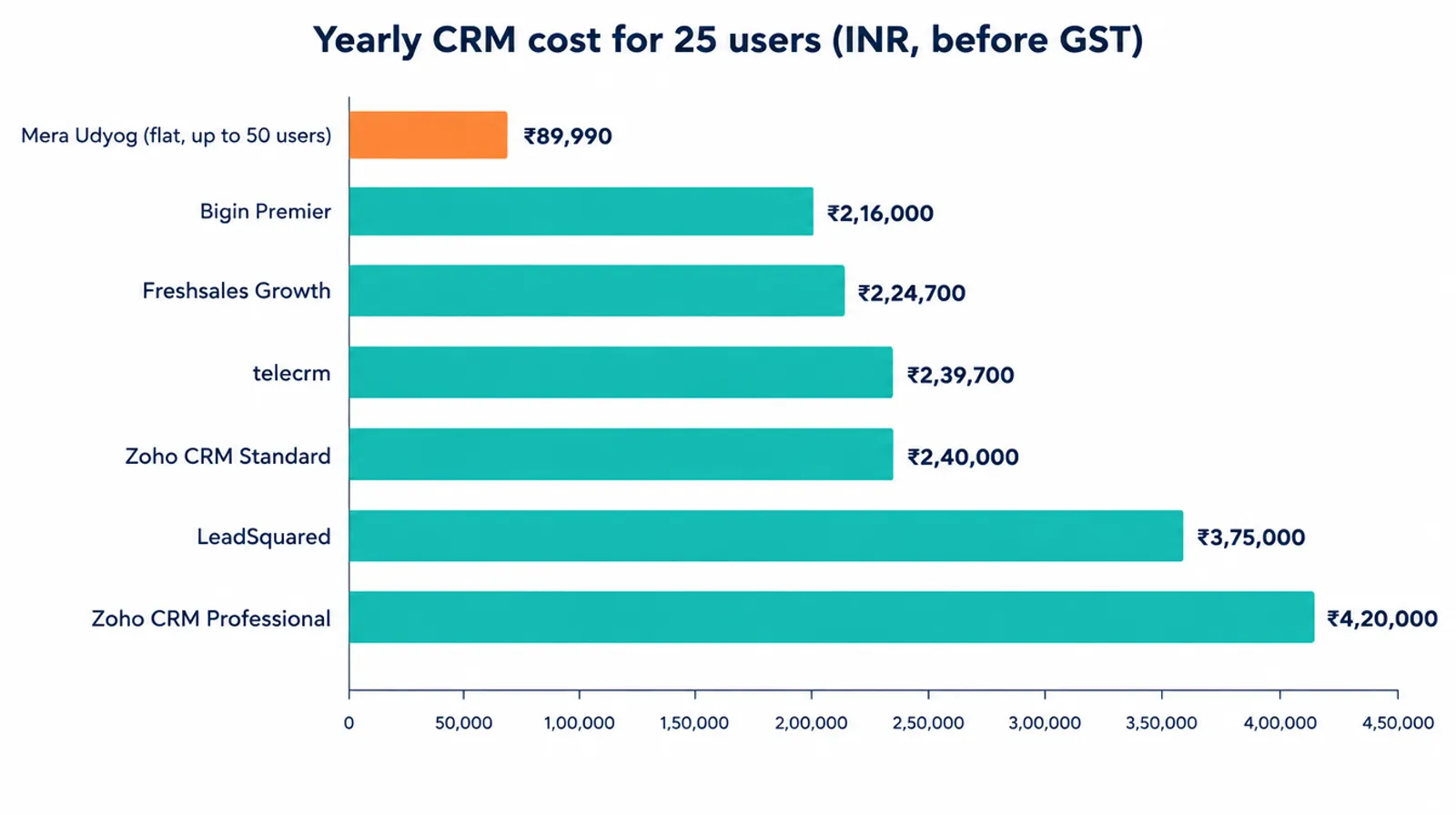
A manufacturing CRM for a 25-person team costs roughly ₹2.16 lakh to ₹4.2 lakh a year before GST on the per-user plans in this guide, or ₹89,990 a year on Mera Udyog’s flat plan. We calculated these figures ourselves from each vendor’s listed annual price, multiplied by 12 months and the number of users.
Here’s the full table:
| Plan (annual billing) | 10 users / year | 25 users / year | 50 users / year |
|---|---|---|---|
| Bigin Premier (₹720) | ₹86,400 | ₹2,16,000 | ₹4,32,000 |
| Freshsales Growth (₹749) | ₹89,880 | ₹2,24,700 | ₹4,49,400 |
| telecrm (₹799) | ₹95,880 | ₹2,39,700 | ₹4,79,400 |
| Zoho CRM Standard (₹800) | ₹96,000 | ₹2,40,000 | ₹4,80,000 |
| LeadSquared (from ₹1,250) | ₹1,50,000 | ₹3,75,000 | ₹7,50,000 |
| Zoho CRM Professional (₹1,400) | ₹1,68,000 | ₹4,20,000 | ₹8,40,000 |
| Mera Udyog (flat, up to 50 users) | ₹89,990 | ₹89,990 | ₹89,990 |
All figures exclude 18% GST. Add GST and Mera Udyog’s yearly plan comes to about ₹1,06,188.
Here’s the honest read:
- At 10 users, the options cost about the same. If you only need a sales pipeline, Bigin Express at ₹400 per user (₹48,000 a year for 10 users) is cheaper than anything else here.
- At 25 users, a flat plan starts to win clearly. Mera Udyog works out to about ₹300 per user per month.
- At 50 users, Mera Udyog is about ₹150 per user per month, and it includes billing, attendance, payroll and stock that per-user CRMs charge for separately or don’t offer.
Important
Many factories count only sales staff when pricing a CRM. But supervisors, dispatch and accounts also need logins to close stages 5 to 7. Count every person who touches an order.
Don’t forget the hidden costs: telephony or WhatsApp add-ons, setup partners, data migration from Excel, and training time. Our best CRM software in India guide breaks down hidden CRM costs for 5 to 20 user teams.
CRM for Multi-Plant and Multi-Outlet Manufacturers
A CRM for multi-plant and multi-outlet manufacturers must give each location manager their own view while head office sees everything combined. Without branch-wise access, plant managers either see too much data or nobody trusts the shared numbers.
Typical setups we see in Indian manufacturing:
- One head office, two or three plants: orders route to the plant with capacity or the shortest freight distance.
- A plant plus company-owned outlets: the plant makes, outlets sell, and stock moves between them.
- A plant plus depots for dealers: dealers order from the nearest depot.
For example, Sidheshwarr RMC in Nagpur runs 3 plants, 1 head office and 200+ staff on Mera Udyog (case study).
Here’s what to check in a demo:
- Can you create plants, outlets and warehouses as separate locations?
- Can a plant manager log in and see only their location’s enquiries, orders and staff?
- Do orders route to a location automatically, or does someone forward them by WhatsApp?
- Can head office compare locations side by side in one report?
If you sell through outlets too, our retail management software page shows how outlet-level stock and sales tie back to head office. For the plant side, see manufacturing ERP software.
The Factory CRM Fit Scorecard (Free Checklist)
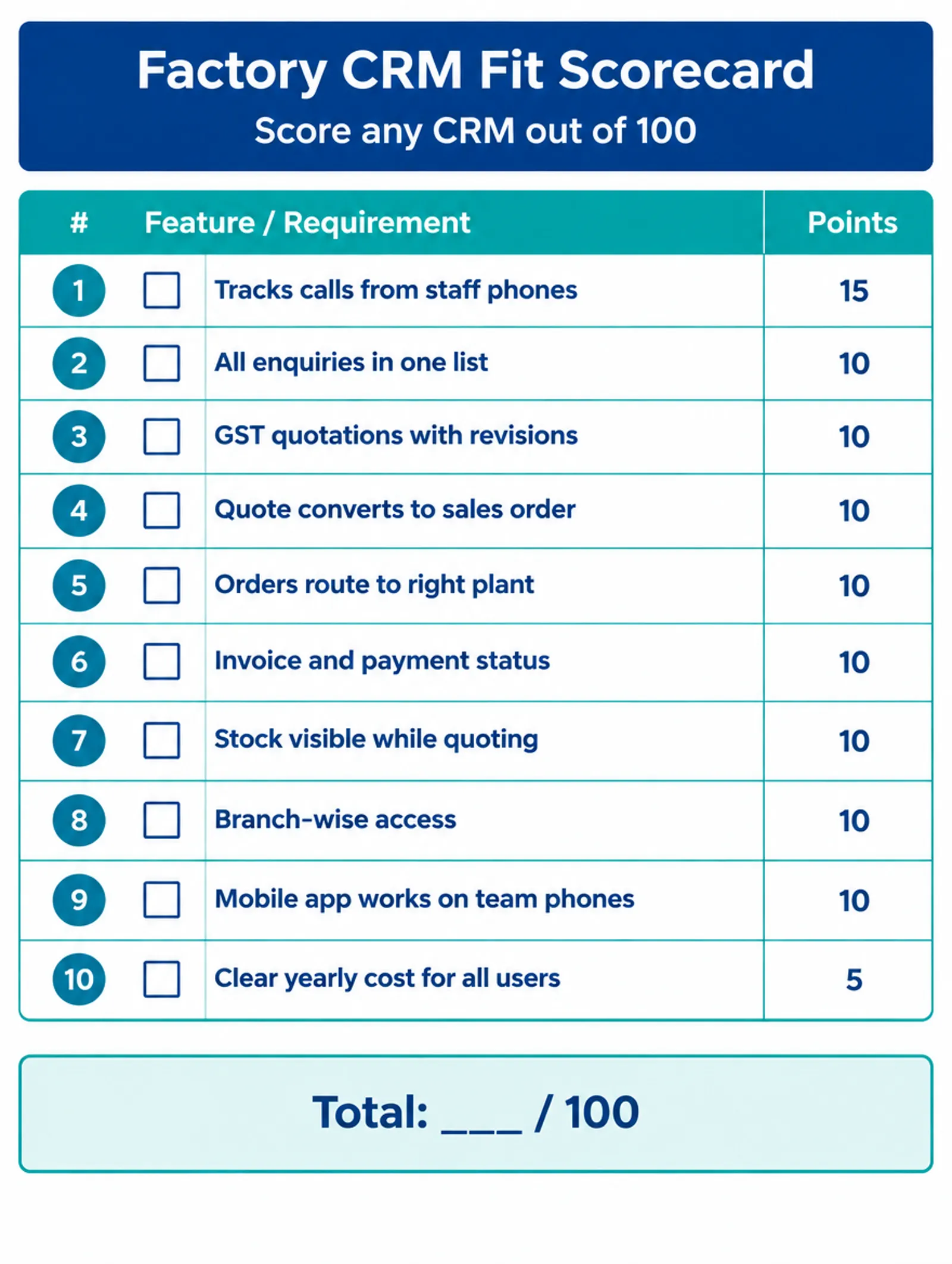
The Factory CRM Fit Scorecard is a 10-question checklist that scores any CRM out of 100 for a small Indian manufacturer. Score each tool during the demo, add the points, and compare totals instead of comparing brochures.
| # | Question | Points if yes |
|---|---|---|
| 1 | Does it track calls made from staff’s own phones? | 15 |
| 2 | Do IndiaMART, website and QR enquiries land in one list? | 10 |
| 3 | Can you create GST quotations with revisions? | 10 |
| 4 | Does a quote convert into a sales order? | 10 |
| 5 | Do orders route to the right plant or branch? | 10 |
| 6 | Can sales see invoice and payment status? | 10 |
| 7 | Is stock visible while quoting? | 10 |
| 8 | Does each branch manager see only their location? | 10 |
| 9 | Does the mobile app work on your team’s phones? | 10 |
| 10 | Is the yearly cost for every user who touches an order clear upfront? | 5 |
How to read your score:
| Score | What it means |
|---|---|
| 80 to 100 | Covers your full enquiry-to-payment cycle |
| 50 to 79 | Works, but you’ll run a second or third tool alongside it |
| Below 50 | A lead list, not a manufacturing CRM |
How to Roll Out a CRM in a Small Factory in 30 Days
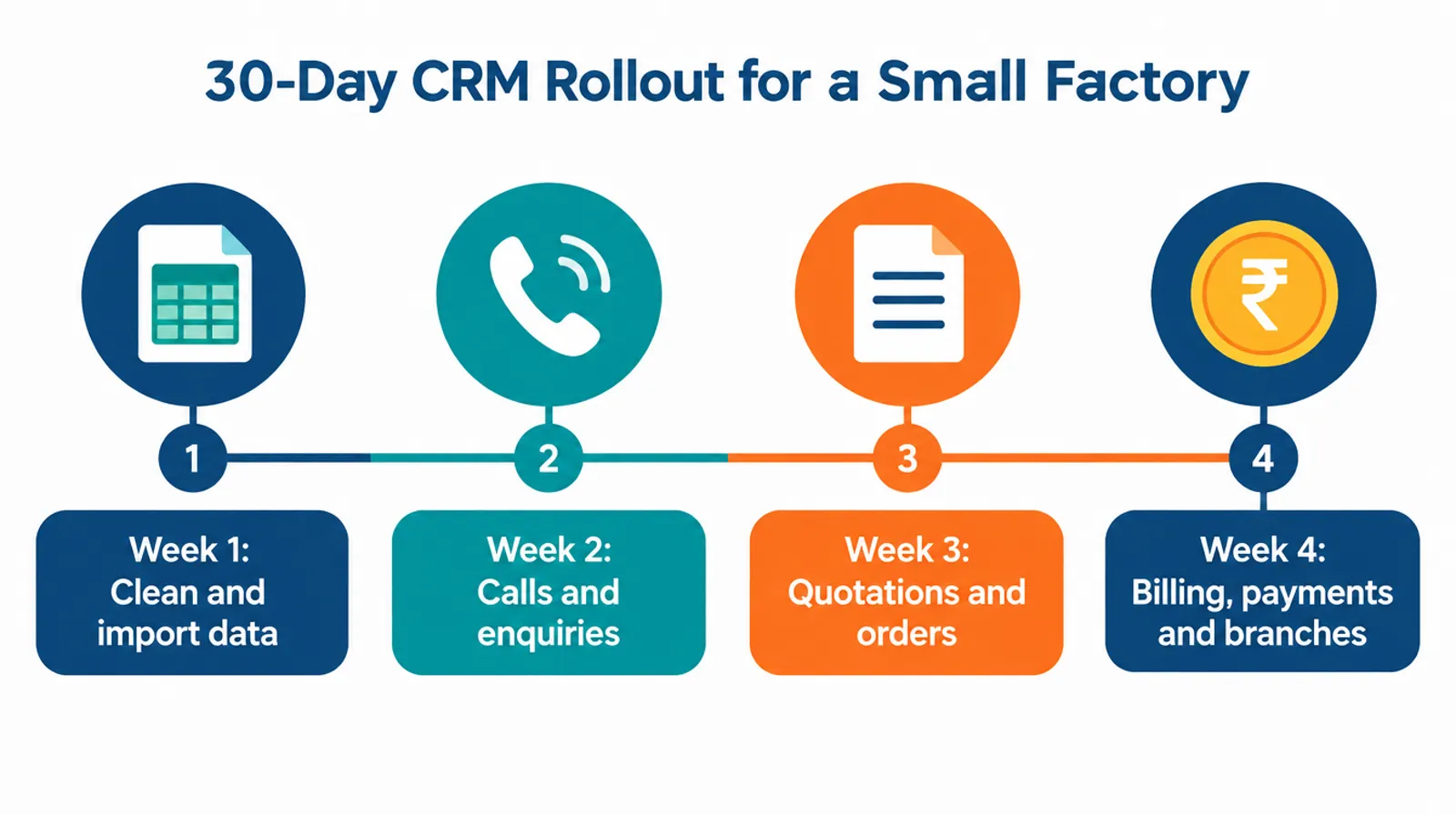
You can roll out a CRM in a small factory in about 30 days by starting with one team, one data source and one daily habit, then adding stages week by week. Trying to switch everything on day one is the most common reason CRM projects stall.
| Week | Focus | What to do |
|---|---|---|
| 1 | Clean and import | Collect buyer and dealer lists from Excel and phones. Remove duplicates, then import only active customers from the last 12 months. |
| 2 | Calls and enquiries only | Ask the sales team to log every call and enquiry. The owner checks the dashboard each evening for untouched leads. |
| 3 | Quotations and orders | Move quotations into the CRM and convert approved quotes to sales orders. Stop accepting quotations sent outside the system. |
| 4 | Billing, payments and branches | Connect invoicing and payment status, then give plant or outlet managers their branch logins. |
Pro tip
Run a 10-minute standup every morning from the CRM dashboard for the first month. When the owner uses the screen, the team fills it in.
5 Mistakes Manufacturers Make When Buying a CRM
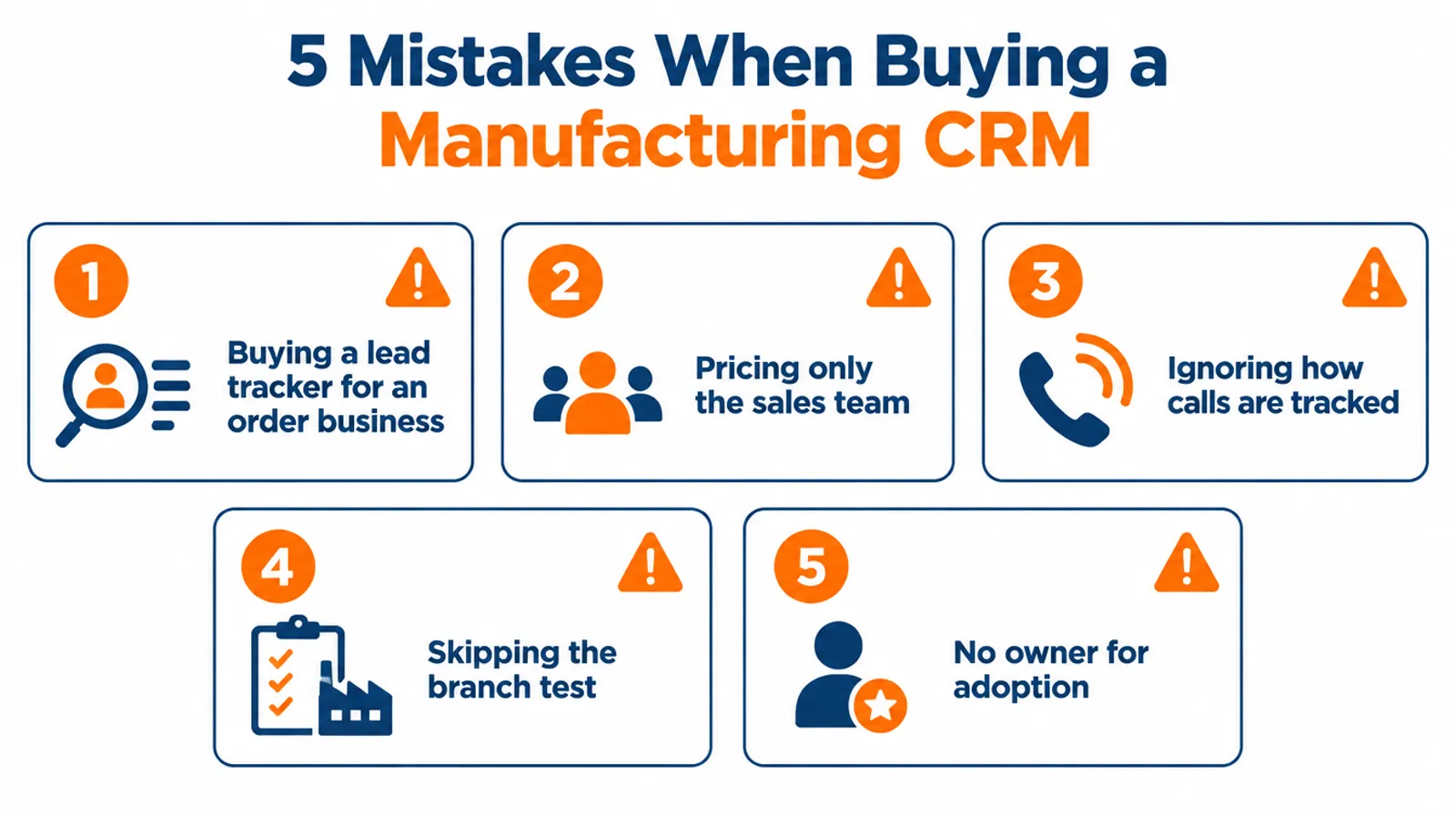
Buying a CRM for a manufacturing company usually goes wrong for one reason: owners pick by price per user or brand name instead of by how many enquiry-to-payment stages the tool covers. These five mistakes come up again and again.
- Buying a lead tracker for an order business. If the tool stops at “deal won”, dispatch and collections stay in Excel.
- Pricing only the sales team. Supervisors, dispatch and accounts need access too, which multiplies per-user costs.
- Ignoring how calls are tracked. If the CRM needs a new phone number your buyers don’t know, your team will keep calling from personal phones.
- Skipping the branch test. A single shared login across plants creates confusion and data nobody trusts.
- No owner for adoption. A CRM nobody checks becomes an empty database in 60 days.
Now It’s Your Turn
A CRM for manufacturing industry earns its cost when it covers the whole journey, from the first IndiaMART enquiry to the payment landing in your account. Map your 7 stages, score each tool with the Factory CRM Fit Scorecard, and price every user who touches an order.
Want to see how one app covers CRM, billing, stock and attendance across your plants? Book a free Mera Udyog demo.
Frequently asked questions
What is the best CRM for manufacturing industry in India?
The best CRM for manufacturing industry in India depends on team size and scope. Small sales-only teams can start with Bigin by Zoho or Freshsales, dealer-heavy field teams often look at LeadSquared, and manufacturers with 20 to 500 people who want CRM, GST billing, inventory and attendance in one app can consider Mera Udyog at ₹89,990 a year plus GST for up to 50 users.
How much does a CRM for a manufacturing company cost in India?
A CRM for a manufacturing company in India typically costs ₹400 to ₹1,400 per user per month on annual billing for common plans, before 18% GST. For 25 users that is about ₹2.16 lakh to ₹4.2 lakh a year on per-user plans, while flat plans such as Mera Udyog cost ₹89,990 a year for up to 50 users.
Is there a free CRM for small manufacturing businesses?
Yes, a few CRMs have free plans: Zoho CRM is free for up to 3 users, and Bigin by Zoho and Freshsales also offer free editions. Free plans suit very small teams but usually lack quotations, sales orders, billing and branch-wise access that manufacturers need.
What is the difference between CRM and ERP for manufacturing?
A CRM manages customers and sales: enquiries, calls, quotations and follow-ups. An ERP manages operations such as production, purchase, inventory and accounts. Many small manufacturers need both, which is why some tools combine CRM with billing and inventory in one system.
What is SIM-based calling in a CRM?
SIM-based calling is a CRM feature that tracks calls made from a salesperson’s own mobile SIM, recording who called whom and for how long. It needs no new virtual number, unlike cloud telephony, so buyers keep calling the number they already know.
About the Author
This guide is written by the Mera Udyog Team, which builds attendance, payroll, sales and billing software for Indian manufacturers and multi-outlet retailers. Questions about this guide? Write to hello@meraudyog.com.
Sources we checked (11)
- IndiaMART Q2 results press release (quarter ended Sep 30, 2026), 2026
- Over 7.9 crore enterprises register through Udyam platforms, IANS via Lokmat Times, 2026
- Nucleus Research: CRM pays back $8.71 for every dollar spent, 2014
- Bigin by Zoho India pricing clarification, 2025
- Zoho CRM pricing in India, IT for SME, 2026
- Freshsales pricing in India, IT for SME, 2026
- telecrm pricing, 2026
- Zoho CRM Professional edition features, 2026
- LeadSquared manufacturing CRM, 2026
- IndiaMART integration for Zoho CRM, Zoho Community
- Mera Udyog pricing, 2026